
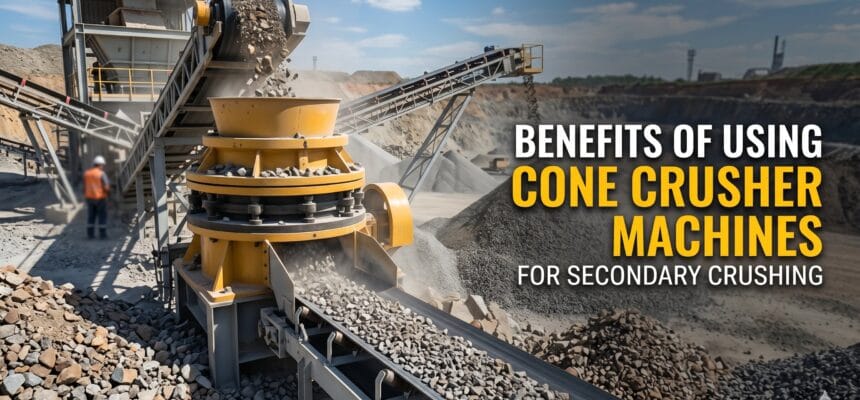
Secondary crushing is where the real value is captured in aggregate production. Whether you’re processing limestone, granite, basalt, or recycled concrete, the machine you choose determines everything — throughput, product shape, operational downtime, and ultimately, your bottom line.
- Why Secondary Crushing Matters?
- Precision: The Hidden Value
- Productivity: Throughput That Stays Consistent
- Operational Cost Reduction: Where Numbers Get Real
- Comparison: Cone Crusher vs. Other Secondary Equipment
- Choosing and Sourcing a Cone Crusher Machine in the UAE
- Frequently Asked Questions
- What’s the difference between a cone crusher and an impact crusher for secondary crushing?
- How often do you need to replace the mantle and bowl liners in a cone crusher machine?
- Is a stationary cone crusher worth it compared to a mobile cone crushing unit?
- What’s the typical ROI timeline on buying a new cone crusher machine versus continuing with worn-out equipment?
A quality cone crusher machine represents a substantial investment, but the gains in precision, productivity, and cost efficiency make it one of the most critical decisions an operator can make when scaling production.
In the Middle East and North Africa, where demand for high-quality aggregates continues to grow, operators are increasingly turning to cone crushers for secondary and tertiary crushing stages. If you’re evaluating whether to buy a cone crusher machine or upgrade an existing setup, understanding the tangible benefits — beyond just “it crushes rocks” — is essential to justifying the capital and optimising performance over years of operation.

Why Secondary Crushing Matters?
Primary crushing (jaw crushers) reduces run-of-mine material to manageable sizes. Secondary crushing is where consistency, product quality, and efficiency intersect. A cone crusher machine excels at this stage because it processes the intermediate product into tightly sized, well-shaped aggregates with minimal fines generation — and it does so with remarkable consistency.
The difference between a well-executed secondary crushing stage and a poorly optimized one can be 15–25% in throughput recovery alone, before you even factor in product quality premiums or the cost of re-crushing out-of-spec material.
Precision: The Hidden Value
Modern cone crusher machines operate on a deceptively elegant principle: a mantle (the moving inner surface) gyrates against a fixed bowl (outer surface), progressively reducing material toward the discharge opening. The smaller the gap at the bottom, the finer the product — and operators can adjust this setting hydraulically, often without stopping the machine.
This means you can maintain a ±2–3 mm product grading across operating conditions. Compare that to older jaw crushers or poorly maintained equipment, where you might see ±8 mm variance, and suddenly you’re dealing with a fundamentally different product consistency.
Precision Advantage:
Consistent Gradation Output: A cone crusher machine maintains tight product sizing tolerances, reducing the percentage of oversized and undersized material. This consistency commands premium pricing and reduces rework costs — particularly valuable when supplying to ready-mix concrete producers or road construction projects where grading specifications are non-negotiable.
Productivity: Throughput That Stays Consistent
Cone crushers are workhorses. Modern designs process 100–500+ tonnes per hour (depending on machine model and material type), and critically, they maintain this throughput across varying input sizes and material hardness. A cone crusher machine in UAE operations routinely delivers 16+ hour days without the wear-related throughput decline seen in older jaw crusher designs.
The secret is the gyratory motion combined with an eccentric bearing assembly that distributes stress evenly. High-speed operation (upward of 1500 rpm in some designs) means more crushing events per minute, which translates to finer product with fewer passes through the system.
Typical Throughput
100–500+ Tonnes/hour
Operating Speed
1300–1600 RPM range
Product Grading
±2–3 MM variance
Daily Runtime
16+ Hours possible
Operational Cost Reduction: Where Numbers Get Real
The headline benefit of a cone crusher machine is usually throughput. But savvy operators focus on cost per tonne — and that’s where the real gains sit.
Power consumption: Modern cone crushers operate at 30–50 kW (smaller models) up to 150+ kW for large stationary units. Over a year of production, the cost is high — but optimized hydraulic systems and energy-efficient motors have reduced consumption by 15–20% versus equipment from a decade ago. Additionally, the ability to adjust settings without shutting down means fewer power cycles and more efficient energy use.
Maintenance and wear parts: Mantle and bowl liners are the wear items in a cone crusher. Quality liners last 12,000–20,000 operating hours, depending on material abrasiveness. Compare that to jaw plates, which often need replacement every 5,000–8,000 hours — and you’re looking at a significant reduction in downtime and spare parts inventory.
Fines generation: A well-tuned cone crusher produces 5–10% fines (material passing 75 microns), whereas poor secondary crushing can generate 15–25%. Fines have lower value and often require recirculation or disposal. Minimizing fines directly improves saleable product yield.
Cost Efficiency Metric:
Operating cost per tonne: can drop 20–30% when upgrading to a modern cone crusher machine compared to older equipment, after factoring in reduced wear parts consumption, lower fines generation, and improved throughput consistency.
Comparison: Cone Crusher vs. Other Secondary Equipment
| Factor | Cone Crusher | Impact Crusher | Jaw Crusher (2nd stage) |
|---|---|---|---|
| Product Shape | Excellent (cubic) | Good (more rounded) | Fair (more flaky) |
| Gradation Control | ±2–3 mm | ±4–5 mm | ±5–8 mm |
| Fines % | 5–10% | 10–15% | 15–25% |
| Wear Cost/yr | Lower | Medium | Higher |
| Maintenance Downtime | 12–16 hr/year | 20–30 hr/year | 30–50 hr/year |
Choosing and Sourcing a Cone Crusher Machine in the UAE
If you’re ready to buy a cone crusher machine or evaluate options to find a cone crusher machine for sale, sizing the machine correctly to your feed material and production targets is critical. Key parameters to assess:
Feed size: Maximum input size your primary crusher produces. Cone crushers typically handle up to 100–150 mm feed in secondary applications.
Material type: Hardness (Mohs scale) and abrasiveness affect wear rates and throughput. Granite and basalt are harder than limestone; recycled concrete falls in between.
Target product size: Your discharge setting determines output gradation. Flexibility to adjust this without a shutdown is valuable.
Power availability: Confirm your site can supply the required three-phase power and backup capacity for peak operation.
Reputable suppliers in the UAE typically offer installation, commissioning, and spare parts support — factors that matter more than headline price when considering equipment reliability over 10+ years of operation.
Frequently Asked Questions
What’s the difference between a cone crusher and an impact crusher for secondary crushing?
The fundamental difference is the crushing mechanism. A cone crusher uses compression — material is squeezed between the mantle and bowl — which produces cubic, well-shaped aggregate with excellent interlocking properties. Impact crushers use, well, impact — material is thrown against a stationary anvil plate at high velocity. Impact crushers excel at handling tough, non-abrasive materials and can shift product shape more easily by changing anvil geometry.
However, for consistent gradation and minimal fines generation, cone crushers win. Impact crushers are faster for large lump crushing but produce more fines and less predictable product sizing. For secondary crushing targeting consistent aggregate for concrete or road base, cone crushers deliver superior product quality and predictability.
How often do you need to replace the mantle and bowl liners in a cone crusher machine?
Mantle and bowl liner life depends heavily on material abrasiveness. For softer materials like limestone, you can often get 15,000–20,000 operating hours. For harder materials like granite or basalt, expect 8,000–12,000 hours. This translates to roughly 2–4 years of operation if you’re running 5,000+ hours annually.
When wear reaches a certain point (typically 30–40% thickness loss), crushing performance drops and fines generation increases — so most operators plan replacement proactively. Quality aftermarket liners cost roughly 15–25% less than OEM parts but may not last as long. Budgeting for liner replacement as a routine maintenance item, rather than a surprise expense, helps keep operational costs predictable.
Is a stationary cone crusher worth it compared to a mobile cone crushing unit?
This depends on your operation’s nature. Stationary cone crushers are fixed installations at your primary processing site — higher capital cost, but exceptional consistency and throughput for long-term operations. Mobile cone crushers (mounted on wheels or tracks) cost more upfront but offer flexibility to move between sites — valuable if you’re contract crushing or exploring multiple quarries. For a permanent quarry or aggregate pit, stationary wins on lifecycle cost.
For contract work or sites you’ll leave in 2–3 years, mobile makes sense. The real factor: stationary units can run 20+ hours daily reliably; mobile units are typically rated for 16-hour days due to power and cooling constraints. If your business model is high-volume, long-term production, then stationary is almost always the better return.
What’s the typical ROI timeline on buying a new cone crusher machine versus continuing with worn-out equipment?
A quality cone crusher machine typically costs AED 500,000–2,000,000+, depending on size and features. The ROI depends on your production volume and the current equipment’s inefficiency. If you’re producing 50,000+ tonnes annually and your current equipment has high downtime (30+ hours/year), excessive wear part costs, or poor product quality requiring rework, the payback is often 2–4 years. The calculation: improved throughput (more saleable tonnes) + reduced wear part costs + reduced downtime + higher-grade product premium pricing all stack up.
In UAE operations with high labour costs and steady demand, upgrading to a modern cone crusher machine almost always pencils out within 3–5 years if production volume justifies the capex. For lower-volume operations (under 20,000 tonnes/year), the ROI extends beyond 5 years, which makes upgrading less attractive unless operational disruption from current equipment becomes critical.
Thanks, bigbloger.com