


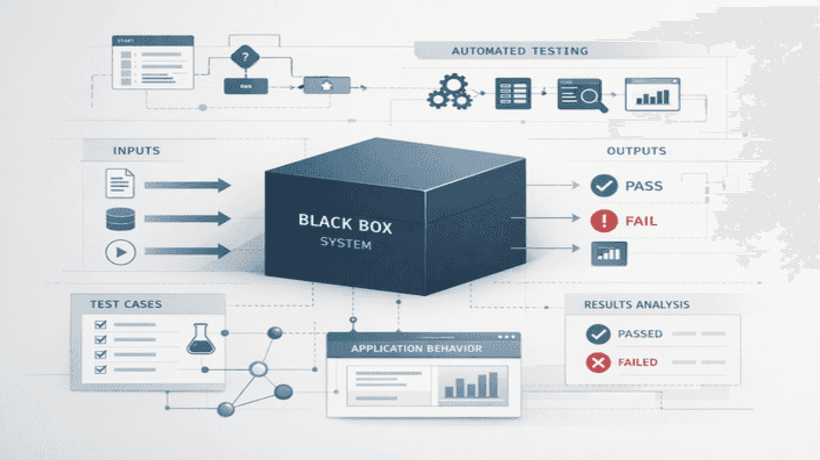

Black Box Testing from a Developer’s Perspective
Black box testing is usually explained in the simplest way possible:
- The Moment You Stop Trusting Your Own Code
- Inputs Are Easy. Behavior Is Not.
- Thinking Like a User (Even When You’re Not One)
- When Systems Stop Being Predictable
- The Subtle Role of Experience
- Where Black Box Testing Falls Short
- The Balance Developers Actually Maintain
- Why This Perspective Still Matters
- Final Thoughts
You don’t look at the code. You test inputs and outputs.
Clean. Straightforward. Easy to understand.
But that’s not how it feels when you’re actually building software.
From a developer’s perspective, black box testing is less about ignoring the code and more about stepping away from it – trying to see the system the way users and other systems experience it.
And that’s harder than it sounds.
The Moment You Stop Trusting Your Own Code
When you write a piece of logic, you understand it.
You know why it works. You know what it’s supposed to do. You know the assumptions behind it.
That’s exactly the problem.
Because when you test your own code with that mindset, you’re not really testing – you’re confirming what you already believe.
Black box testing forces a shift.
It asks you to forget how the system is built and focus only on what it does.
That change in perspective is where real issues start to surface.
Inputs Are Easy. Behavior Is Not.
Most discussions around black box testing revolve around inputs and expected outputs.
But in real systems, behavior is rarely that linear.
The same input can lead to different outcomes depending on:
System state
Data conditions
External dependencies
Timing and concurrency
So developers don’t just think in terms of inputs anymore.
They start asking:
What happens if this request is repeated?
What if the system is already in a partial state?
What if another service responds differently?
Black box testing becomes less about validation and more about exploration.
Thinking Like a User (Even When You’re Not One)
Developers don’t always use the product the way real users do.
Users:
Click things in unexpected orders
Enter incomplete or inconsistent data
Abandon workflows halfway
Come back later and continue
From a developer’s perspective, black box testing means trying to simulate that unpredictability.
Not perfectly – but intentionally.
It’s about breaking the “happy path” mindset and asking:
What happens when things don’t go as planned?
When Systems Stop Being Predictable
In small applications, behavior is easier to reason about.
In larger systems – especially distributed ones – things get complicated quickly.
You might send a request and:
One service responds instantly
Another is delayed
A third fails silently
From the outside, all you see is the result.
That’s where black box testing becomes powerful.
You’re not concerned with which service failed or why. You’re observing the system as a whole and asking:
Does this outcome make sense?
The Subtle Role of Experience
No one sits down and says, “Now I will perform black box testing.”
It happens naturally.
A developer runs a feature and thinks:
This feels slower than expected
This response doesn’t look right
This flow is confusing
That instinct is a form of testing.
Over time, developers get better at spotting inconsistencies – not by analyzing code, but by observing behavior. Developers don’t always formalize their approach, but familiarity with different black box testing types often shapes how they think about edge cases, boundary conditions, and unexpected user flows.
This is where understanding different black box testing types becomes useful, even if not formally applied. It helps developers think in patterns – edge cases, boundary conditions, unexpected flows – without turning it into a rigid process.
Where Black Box Testing Falls Short
Despite its strengths, black box testing has limits.
From the outside, you can see what is wrong, but not why. This is where the distinction between black box vs white box testing becomes clear – one focuses on observing behavior, while the other helps uncover what’s happening inside the system.
You might detect:
Incorrect responses
Missing data
Broken workflows
But debugging still requires going inside the system.
So developers don’t rely on black box testing alone.
They use it as a first layer – a way to catch visible issues before digging deeper.
The Balance Developers Actually Maintain
In real projects, testing isn’t split cleanly into categories.
Developers constantly switch perspectives:
Sometimes thinking like the system
Sometimes thinking like a user
Sometimes focusing on edge cases
Sometimes just checking if things “feel right”
Black box testing is one of those perspectives.
Not a strict method. Not a checklist. Just a way of looking at the system from the outside.
Why This Perspective Still Matters
As systems grow more complex, it becomes harder to understand everything from the inside.
There are too many services, too many interactions, too many moving parts.
At that point, behavior becomes the only reliable signal.
If the system behaves correctly, it works.
If it doesn’t, something needs attention – regardless of where the issue lies.
That’s why black box testing remains relevant.
It simplifies complexity by focusing on outcomes.
Final Thoughts
Black box testing isn’t just about ignoring code.
It’s about changing how you see the system.
From a developer’s perspective, that shift is what makes it valuable.
Because no matter how well you understand your code, the real question is always the same:
Does it work the way it’s supposed to – when someone actually uses it?