
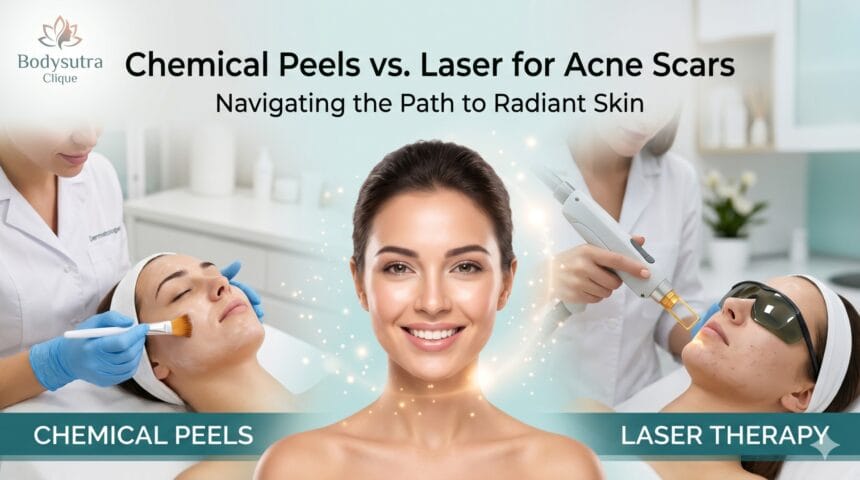

Acne is often a temporary visitor, but the scars it leaves behind can feel like permanent residents. For many, the journey doesn’t end when the breakouts stop; it simply shifts to a quest for skin texture restoration. In the world of modern dermatology, two heavyweights dominate the conversation: Chemical Peels and Laser Resurfacing. Both offer transformative results, but they operate on fundamentally different principles.
Whether you are dealing with superficial post inflammatory hyperpigmentation (PIH) or deep, structural tethered scars, choosing the right modality is essential for safety and efficacy. This is particularly true for Indian skin tones, which require a specialized, cautious approach to prevent secondary issues like rebound pigmentation. At Bodysutra Clinique, we believe that understanding the science behind these treatments is the first step toward reclaiming your confidence.
Understanding the Architecture of Acne Scars
Before comparing treatments, it is vital to understand what we are treating. Not all scars are created equal:
- Atrophic Scars: These are indentations caused by a loss of tissue. They include “Ice pick” (narrow and deep), “Boxcar” (broad with sharp edges), and “Rolling” (shallow with undulating edges) scars.
- Hypertrophic Scars: These are raised, thickened areas where the body has produced too much collagen during the healing process.
- Pigmented Marks: Technically not scars but “stains,” these are flat red or brown spots left after an acne lesion heals.
Chemical Peels: The Art of Controlled Exfoliation
Chemical peeling is one of the oldest and most reliable methods in dermatology. It involves applying a medical grade acidic solution to the skin to intentionally “injure” the top layers. As the damaged skin peels away, a new, smoother layer emerges from beneath.
How They Work
Peels are categorized by their depth of penetration:
- Superficial Peels: Use Alpha Hydroxy Acids (AHAs) like Glycolic or Mandelic acid. These are excellent for mild scarring and evening out skin tone.
- Medium Depth Peels: Often utilize Trichloroacetic Acid (TCA). These reach the papillary dermis and are effective for shallow atrophic scars.
- Deep Peels: These reach the mid dermis but are less commonly used on darker skin types due to the high risk of permanent pigment loss.
The Verdict for Scars
Chemical peels are “surface specialists.” They excel at treating skin texture and superficial scarring. For patients with active acne or early stage scarring, a series of peels can stimulate cell turnover and prevent deeper damage.
Laser Treatments: Precision and Deep Remodeling
Laser technology has revolutionized scar management by offering a level of precision that chemical solutions cannot match. Instead of a blanket application of acid, lasers use concentrated light energy to target specific depths.
Types of Lasers for Scars
- Fractional CO2 Laser: The gold standard for deep, pitted scars. It creates thousands of microscopic “thermal zones” in the skin, leaving surrounding tissue intact. This triggers a massive “wound healing” response that produces fresh collagen to fill in the indentations.
- Erbium:YAG Laser: A gentler alternative to CO2, often preferred for those with sensitive skin or a lower threshold for downtime.
- Non Ablative Lasers: These heat the deeper tissue without damaging the surface. They have zero downtime but require more sessions for visible results.
The Verdict for Scars
Lasers are “structure specialists.” If your scars are deep or structural, a laser can reach depths that a chemical peel simply cannot. While the recovery time (downtime) is often longer usually 5 to 7 days of redness and “bronzing” of the skin the results are typically more dramatic.
Key Comparisons: Making the Choice
Choosing between the two depends on your Fitzpatrick Skin Type (how your skin reacts to the sun) and your lifestyle.
For Superficial Concerns: Chemical Peels are generally more affordable per session and involve minimal downtime, usually appearing as mild flaking for 1 to 3 days. They are ideal for those looking to improve overall radiance alongside mild scar correction.
For Deep Seated Issues: Laser Resurfacing is the superior choice for deep pits or rolling scars. While it requires a higher investment per session and a longer recovery period (5 to 10 days of redness and crusting), it often necessitates fewer sessions typically 3 to 5 compared to the 6 to 8 sessions often required for peels.
Beyond Scars: Managing Chronic Skin Health
While acne scars are a primary concern for many, skin health is a holistic journey. Chronic conditions can often overlap with aesthetic concerns, complicating the treatment plan. For instance, individuals dealing with inflammatory conditions like psoriasis must ensure their skin is in a stable state before undergoing aggressive resurfacing.
Managing the immune response and localized inflammation is a prerequisite for any cosmetic intervention. If you are seeking specialized care for autoimmune skin flares, finding an expert who offers comprehensive acne treatment in PCMC is essential to ensure that your skin barrier is healthy enough to withstand the “controlled injury” of a laser or a peel.
The Power of Combination Therapy
In modern dermatology, we rarely choose just one. The most impressive results often come from a “Multi Modality” approach. For instance, a dermatologist might use a TCA CROSS technique (applying high strength acid directly into a deep pit) followed by a Fractional CO2 Laser session to smooth the overall texture.
Subcision a minor surgical procedure to break up the fibrous bands pulling the skin down is also frequently paired with lasers to ensure the “floor” of the scar can actually rise once the collagen is stimulated.
Pre and Post Procedure Care
Regardless of the treatment you choose, the “prep” and “aftercare” determine 50% of your result.
- Priming: You may be asked to use Tyrosinase inhibitors (skin lightening creams) for 2–4 weeks before treatment to “silence” the pigment producing cells.
- Sun Protection: This is non negotiable. Post treatment skin is incredibly vulnerable to UV rays. A broad spectrum SPF 50 is your best friend.
- Hydration: Both treatments temporarily disrupt the skin barrier. Using ceramides and hyaluronic acid helps the skin repair itself faster.
Safety for Indian Skin Tones
Indian skin is rich in melanin, making it prone to Post Inflammatory Hyperpigmentation (PIH). If a laser is too hot or a peel is too strong, the skin may overreact by producing dark patches. This is why “aggressive” is not always “better.” A slow, steady, and supervised approach by a qualified dermatologist ensures that you get the glow without the shadow.
Final Thoughts
The “better” treatment is the one tailored to your specific scar type, skin sensitivity, and recovery capacity. While chemical peels are fantastic for a quick refresh and surface level correction, lasers provide the heavy lifting required for structural remodeling.
At the end of the day, your skin is a living organ, not a project to be rushed. By consulting with experts who understand the nuances of both aesthetic and medical dermatology, you can ensure a path that is both safe and effective. Whether you are looking to erase the reminders of past acne or require a therapeutic plan for chronic conditions, a clinical approach remains the gold standard for lasting results.