



The gap between a generative AI model that impresses in a demo and one that performs reliably in a production environment almost always traces back to the same place: the data it was trained on.
- Why Training Data Is the Actual Differentiator
- The Five Stages Where Training Data Quality Gets Made or Lost
- Stage 1: Data Collection and Sourcing
- Stage 2: Curation and Cleaning
- Stage 3: Annotation and Enrichment
- Stage 4: Human Preference Data and Alignment
- Stage 5: Continuous Evaluation and Feedback Loops
- Real-World Examples That Show the Stakes
- The Governance Layer Organizations Keep Underestimating
- What Distinguishes a Serious Training Data Partner
- The Multimodal Dimension
- Final Thought
Architecture matters. Compute matters. But for the teams building and deploying generative AI systems in 2026 foundation models, enterprise LLMs, multimodal applications, the quality, diversity, and governance of training data is where the real work happens. It’s also where the most common and costly mistakes get made.
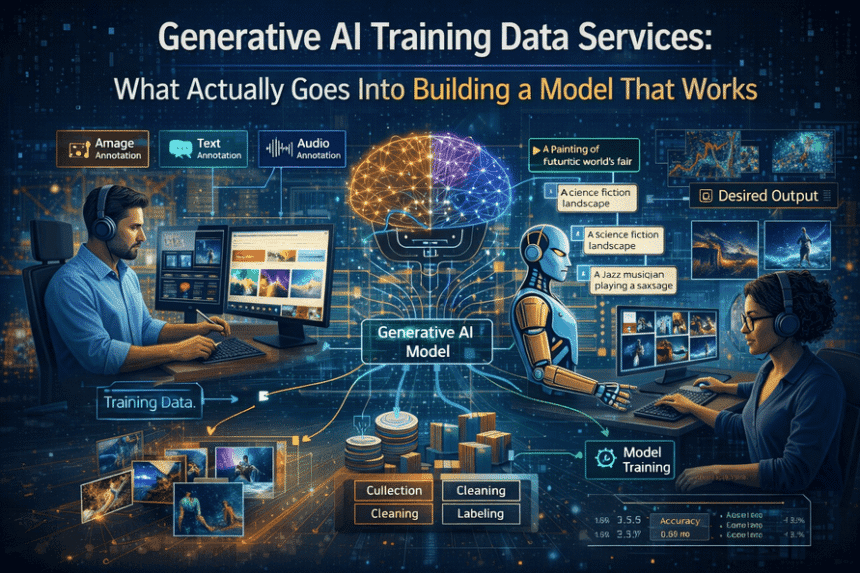
Generative AI training data services cover everything between raw source material and a model-ready dataset: collection, curation, cleaning, annotation, preference labeling, evaluation, and the feedback loops that keep the dataset aligned with the model’s evolving needs. Understanding what each stage requires and what breaks without it gives teams a clearer picture of why this work is harder than it looks and why it’s worth doing well.
Why Training Data Is the Actual Differentiator
For years, progress in AI has been measured by model size. More parameters, bigger compute clusters, longer training runs. That equation has lost much of its force. Models of similar architecture size now vary enormously in performance based on data quality, and smaller, well-trained models consistently outperform larger ones built on noisy or poorly curated datasets.
The implication is significant. Organizations that invest in building distinctive, high-quality training datasets build a durable advantage that compute spending alone can’t replicate. A customer-facing AI system trained on real interaction logs from your specific business context will outperform a general model on your specific use case. A medical AI trained on clinical notes with verified expert annotation produces more reliable outputs than one scraped from unverified health forums.
Data is the differentiation. The model is what learns from it.
The Five Stages Where Training Data Quality Gets Made or Lost
Stage 1: Data Collection and Sourcing
Training data originates from somewhere. The choices made at the sourcing stage, what domains to draw from, what formats to include, and what balance to strike between high-quality curated sources and broad web coverage shape every downstream decision.
For generative AI, sourcing is more complex than for classification tasks. The training data needs to reflect the range of language, style, tone, domain, and format the model will encounter in deployment. A legal drafting assistant needs exposure to legal writing across multiple practice areas, jurisdictions, and document types. A customer service model needs conversational data that reflects how real customers actually communicate, including ambiguous phrasing, incomplete sentences, and domain-specific terminology.
Common sourcing challenges include:
- Licensing and rights: Web-scraped content carries copyright complexity. The EU AI Act and emerging U.S. framework require organizations to document data provenance and rights. Using unlicensed content creates legal exposure that appears later in compliance reviews or litigation.
- Domain balance: Datasets that overrepresent certain domains, writing styles, or demographics produce models with predictable blind spots. Intentional curation for balance takes more effort than simply pulling the most available data.
- Proprietary data handling: Internal datasets, customer records, transaction logs, and operational documents often provide the highest signal for enterprise applications but require careful handling under GDPR, HIPAA, and organizational data governance policies.
Stage 2: Curation and Cleaning
Raw collected data is not training data. It’s source material that needs extensive processing before it can teach a model anything useful.
Curation removes duplicate content, near-duplicate paraphrases, machine-generated text that may contaminate the dataset, and low-quality passages that introduce noise. For text datasets, this includes detecting and filtering spam, boilerplate, encoding errors, and content that violates safety policies.
Cleaning addresses factual errors, inconsistent terminology, formatting anomalies, and metadata gaps. For multilingual datasets, it includes verifying that translations are accurate rather than approximate, a distinction that matters significantly for NLP tasks.
The split between automated cleaning and human review determines what slips through. Automated validators catch systematic problems efficiently. Human reviewers catch the subtle issues, sarcasm misread as sincere, culturally specific idioms stripped of context, and domain terminology flagged incorrectly as noise that automated tools consistently miss.
Stage 3: Annotation and Enrichment
For generative AI, annotation goes well beyond categorical labeling. It captures the intent, tone, factual status, and quality dimensions that teach a model how to generate text that meets human standards.
Annotation tasks for generative AI training data include:
- Response quality labeling: Rating model outputs on dimensions like helpfulness, accuracy, completeness, tone, and safety
- Entity and fact tagging: Marking named entities, factual claims, and their verifiability status within text
- Intent classification: Identifying what a prompt or user query is trying to accomplish a task that requires understanding context, not just keywords
- Toxicity and safety labeling: Identifying harmful, biased, or policy-violating content across multiple categories and severity levels
- Style and tone annotation: Marking voice, register, formality, and persona attributes that teach the model to adapt its output style to context
- Multimodal alignment annotation: For vision-language models, labeling the relationship between image content and associated text to ensure the model learns accurate cross-modal associations
The expertise required for annotation varies by domain. A dataset used to train a financial AI needs annotators who can verify whether a claim about regulatory requirements is accurate, not just whether it sounds authoritative. A medical AI training dataset needs clinical knowledge in the annotation workforce, not just medical terminology familiarity.
Stage 4: Human Preference Data and Alignment
Getting a generative model to produce outputs that are technically accurate isn’t enough. The model also needs to learn what humans actually find useful, where accuracy meets helpfulness, where correctness meets clarity, and where completeness meets appropriate conciseness.
That learning comes from human preference data: structured comparisons where reviewers evaluate model outputs against each other, rank responses on specific dimensions, or provide fine-grained feedback on exactly where a response goes wrong and why.
Preference data feeds RLHF (Reinforcement Learning from Human Feedback) and DPO (Direct Preference Optimization) pipelines. Both require high-quality, consistently labeled preference pairs that reflect genuine human judgment rather than surface-level impressions. Reviewers who can’t evaluate the factual basis of a response can still indicate which one reads more clearly, but only domain-expert reviewers can indicate which one is actually more accurate on the substance.
For enterprise models, preference data often needs to capture company-specific standards: the tone and register appropriate for the brand, the level of technical depth appropriate for the intended user, and the balance between comprehensiveness and conciseness that the use case requires. General-purpose preference data from public annotators doesn’t capture those specifics.
Stage 5: Continuous Evaluation and Feedback Loops
Training data quality degrades over time. Language evolves, product offerings change, regulatory requirements shift, and the model’s deployment surfaces new failure modes that weren’t visible during initial training. A training dataset that was excellent at launch becomes progressively less aligned with what the deployed model needs as those conditions change.
Effective generative AI programs treat data management as an ongoing practice. Performance monitoring flags where the model struggles with specific topics, content types, languages, or query patterns where outputs fall below acceptable quality. Those gaps feed targeted data collection and annotation cycles. Corrected outputs from human reviewers, when structured correctly, become labeled examples for the next training iteration.
This feedback loop deployment performance, informing data collection, informing retraining, is what separates programs that continuously improve from ones that plateau after initial launch.
Real-World Examples That Show the Stakes
OpenAI’s InstructGPT, the paper that introduced RLHF at scale in 2022, showed that a 1.3-billion-parameter model trained on human preference data outperformed a 175-billion-parameter model on human evaluation benchmarks. The smaller model, better aligned through human feedback, produced outputs that people preferred. The paper demonstrated concretely that alignment data quality outweighs raw model size for the outputs users actually care about.
Bloomberg’s BloombergGPT, launched in 2023, demonstrated the domain-specific data advantage. The model trained on a curated corpus of financial news, filings, and documents outperformed general-purpose LLMs on financial NLP benchmarks by a significant margin not because it was larger, but because its training data was domain-specific and high-quality. Organizations building AI for specific professional contexts took note.
Google’s Gemini multimodal training highlighted the annotation complexity of cross-modal alignment. Training a model to accurately describe, interpret, and generate content across text and images requires annotation work that goes well beyond tagging images with keywords it requires structured annotation of the semantic relationship between what’s shown and what’s said, at scale.
These examples share a common thread: the training data decisions, not the architecture decisions, drove the outcome.
The Governance Layer Organizations Keep Underestimating
Every training dataset carries legal and compliance exposure that becomes harder to manage as the model scales.
Copyright and licensing questions around web-scraped training data are in active litigation in the U.S. and EU. The legal landscape hasn’t settled, but organizations building commercial models are building documentation systems now, tracking data sources, rights status, and licensing terms rather than waiting for case law to clarify.
The EU AI Act, which entered application for high-risk AI systems in 2025, requires transparency about training data composition and provenance for models above certain capability thresholds. Organizations deploying models in EU markets need to demonstrate data governance practices that meet regulatory documentation requirements.
GDPR and HIPAA impose strict rules on using personal or health data in training pipelines. Proper de-identification, consent documentation, and data use agreements aren’t optional for organizations handling regulated data types, and the enforcement environment for AI training data violations has tightened.
Data governance is not a compliance tax on the training pipeline. It’s the documentation infrastructure that protects the program when questions arise, and in commercial AI development, questions always arise.
What Distinguishes a Serious Training Data Partner
Organizations that need external support for generative AI training data aren’t all looking for the same thing. But the factors that distinguish providers who deliver reliable results from those who don’t are consistent:
- Domain expertise in the annotation workforce: Reviewers who can actually evaluate the accuracy and quality of outputs in your domain, not just assess surface-level readability
- Established quality control infrastructure: Multi-stage review, IAA measurement, statistical sampling for quality monitoring, and documented audit trails
- Security and compliance posture: SOC 2 Type 2, ISO 27001, and compliance workflows for regulated data types, not just stated policies, but operational controls
- Feedback loop capability: The infrastructure to support continuous annotation programs that update with model iterations, not just one-time dataset builds
- Platform flexibility: Integration with the client’s existing ML stack and annotation tooling, rather than requiring migration to a proprietary platform
Generative AI training services should span the full pipeline, from data collection and curation, prompt and response generation, annotation and enrichment, human preference optimization through both RLHF and DPO, model evaluation, trust and safety labeling, and multilingual support across low-resource languages. Our domain-trained annotator teams work across medical, legal, financial, technical, and general domains, with the quality infrastructure that high-stakes programs require.
The Multimodal Dimension
Generative AI in 2025 and 2026 is increasingly multimodal. Models generate and interpret combinations of text, images, audio, and video. Each modality adds annotation complexity.
Image-text alignment annotation requires labeling how accurately a description captures what’s shown, what details are omitted, and whether any claims about the image are factually accurate. Audio annotation requires transcription with speaker labeling, sentiment and tone marking, and in some applications, paralinguistic feature annotation. Video annotation compounds all of these, adding temporal consistency requirements across frames.
Organizations building multimodal systems need training data programs that cover all relevant modalities with consistent quality standards, not separate workflows bolted together without coherence.
Final Thought
Generative AI training data services are not a support function. They’re the core work that determines what a model learns, how well it aligns with human judgment, how safely it behaves, and how reliably it performs after deployment.
The organizations getting consistent value from generative AI are the ones that treat data quality as a first-class engineering priority, investing in sourcing discipline, annotation expertise, preference data quality, governance infrastructure, and continuous improvement pipelines.