

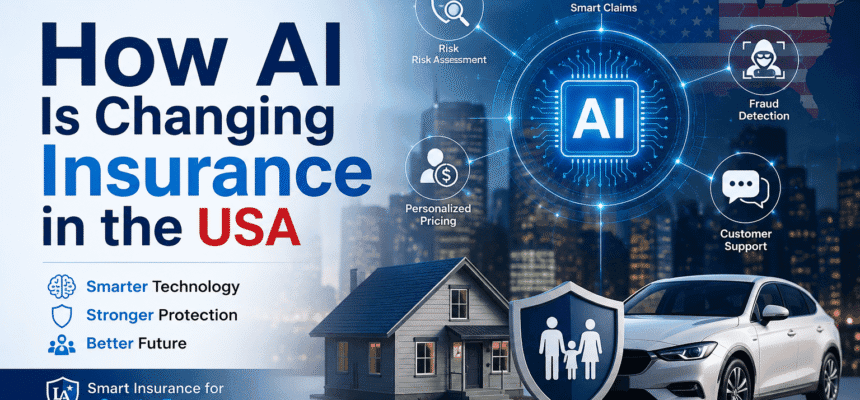

Not long ago, buying insurance meant sitting across from an agent with a stack of paperwork, waiting days for quotes, and spending even longer trying to understand what your policy actually covered.
- Insurance Is Becoming Faster Than Ever
- AI Is Changing How Insurance Prices Are Calculated
- Claims Are Becoming Less Stressful
- Fraud Detection Is Improving Rapidly
- AI Is Also Changing Customer Service
- Smaller Agencies Are Evolving Too
- AI and Weather Risk Prediction
- The Big Concern: Privacy
- Will AI Replace Insurance Agents Completely?
- Final Thoughts
Now? Someone can compare rates on their phone while standing in line for coffee.
That shift did not happen by accident.
Artificial intelligence is quietly reshaping the insurance industry across the United States. And while most people think AI is only about chatbots or futuristic robots, the real changes are happening behind the scenes in ways many drivers and homeowners do not even notice.
From faster claims to smarter pricing, AI is changing how insurance works, how companies make decisions, and how customers experience coverage altogether.
The insurance industry has always been built around risk. AI simply allows companies to understand that risk faster and in greater detail than ever before.
But here’s the interesting part.
Some of these changes are helping customers. Others are raising serious questions.
Let’s unpack both sides.
Insurance Is Becoming Faster Than Ever
Imagine getting into a minor accident on a snowy afternoon.
A few years ago, the process might have looked like this:
Call the insurance company
Wait on hold
Schedule an inspection
Wait days for an estimate
Submit paperwork manually
Now, many insurers use AI tools that can analyze damage from uploaded photos within minutes.
That means:
Faster claim reviews
Quicker repair estimates
Reduced paperwork
Shorter wait times
For customers, this convenience feels almost invisible until they experience it firsthand.
And honestly, after years of slow insurance processes, people appreciate speed.
AI Is Changing How Insurance Prices Are Calculated
This is where things become more personal.
Traditionally, insurance pricing relied heavily on broad categories:
Age
ZIP code
Driving history
Vehicle type
AI goes deeper.
Modern systems analyze patterns from massive amounts of data to predict risk more accurately. Some insurers now evaluate:
Driving habits
Mileage patterns
Braking behavior
Time of day you drive
Claim trends in specific neighborhoods
In other words, insurance is becoming increasingly personalized.
For safe drivers, this can be a good thing. People who drive carefully may receive lower rates than they would under older pricing models.
But there is another side to this conversation.
Some customers worry AI could make pricing feel less transparent. If an algorithm decides your premium, understanding why your rate changed can become more complicated.
Claims Are Becoming Less Stressful
One of the biggest frustrations people have with insurance is the claims process.
Nobody enjoys repeating the same information five times or waiting weeks for updates.
AI is helping reduce that frustration by automating routine tasks.
Some systems now:
Detect missing claim details automatically
Identify fraud patterns instantly
Send repair updates in real time
Route customers to faster solutions
That means claims often move more smoothly than before.
And during stressful moments, simplicity matters.
Fraud Detection Is Improving Rapidly
Insurance fraud costs billions every year in the United States. False claims and exaggerated damages raise costs for everyone else.
AI is becoming one of the industry’s strongest tools against fraud.
It can spot:
Unusual claim patterns
Duplicate repair invoices
Suspicious accident histories
Inconsistencies in documents
What once took investigators days to review can now be flagged almost instantly.
This helps insurance companies reduce unnecessary losses, which may eventually help stabilize costs for honest customers.
AI Is Also Changing Customer Service
Let’s be honest.
Most people do not wake up excited to call their insurance company.
That’s why insurers are using AI-powered systems to improve customer interactions.
Chat tools and automated support can now:
Answer common questions quickly
Provide payment reminders
Explain basic policy information
Help customers start claims anytime
For simple issues, this saves time.
But there’s still something people value deeply during difficult situations: human reassurance.
After a serious accident or home emergency, most customers still want to speak with a real person who understands what they’re going through.
That balance between automation and human connection will likely shape the future of insurance.
Smaller Agencies Are Evolving Too
AI is not only changing giant national companies.
Local agencies are adapting as well.
Many trusted providers, including L.A. Insurance, now use modern technology to simplify quotes, improve response times, and help customers compare coverage more efficiently.
The difference is that local agencies often combine technology with personalized guidance.
That matters because insurance is not just data. It’s personal.
A family choosing coverage for a teenage driver has different concerns than someone insuring a work truck or first apartment. Technology helps organize information, but people still help make sense of it.
AI and Weather Risk Prediction
Weather-related claims are rising across the country.
Floods, hailstorms, wildfires, and severe winters are becoming more expensive for insurers every year.
AI helps companies analyze:
Weather trends
Regional claim risks
Property vulnerability
Emergency response timing
This allows insurers to prepare faster and sometimes warn customers before severe weather hits.
For example, some insurers now send alerts encouraging drivers to move vehicles away from hail zones before storms arrive.
That kind of prevention was much harder years ago.
The Big Concern: Privacy
Of course, not everyone feels comfortable with AI collecting more data.
Many customers wonder:
How much driving data is being tracked?
Who owns that information?
Can it affect future rates unfairly?
These are valid concerns.
As insurance technology evolves, transparency will become more important than ever. Customers want convenience, but they also want clarity and trust.
The companies that communicate openly will likely build stronger long-term relationships.
Will AI Replace Insurance Agents Completely?
Probably not.
Insurance is emotional.
People buy it because they want protection during uncertain moments. And when life gets stressful, human conversations still matter.
AI can:
Speed up systems
Improve efficiency
Analyze data faster than humans
But empathy, guidance, and trust are harder to automate.
That’s why many drivers still prefer working with an experienced Insurance Company near Mt Pleasant that can explain coverage in simple terms instead of relying only on apps and algorithms.
Final Thoughts
AI is changing insurance in the USA in ways that are both exciting and complex.
Claims are faster. Pricing is becoming more personalized. Fraud detection is smarter. Customer service is more efficient.
At the same time, questions about privacy, fairness, and transparency are growing.
The future of insurance will likely combine both worlds:
Smart technology for speed and accuracy
Real people for guidance and trust
And honestly, that balance may be exactly what customers need.
Because while AI can process data in seconds, peace of mind still comes from knowing someone is there when life takes an unexpected turn.