

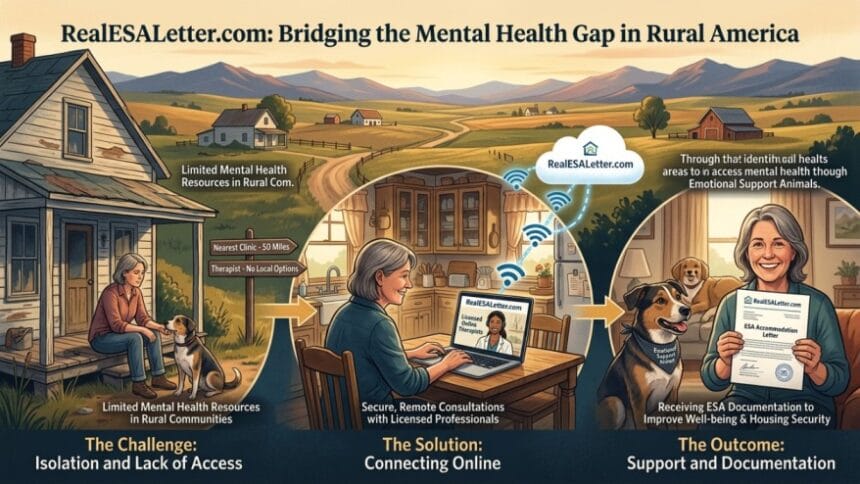

Mental health care has always been harder to access in rural America than in cities and suburbs. Therapist shortages are more acute in small towns. Wait times for appointments stretch into months. And for someone living in a remote county who needs an ESA letter to protect their housing rights, the practical reality of finding a licensed mental health professional nearby can feel close to impossible.
This is the gap that RealESALetter.com was built to close. Through a fully online, telehealth-based process that connects people with licensed professionals credentialed in their state, the platform has become an essential resource for rural tenants who have qualifying mental health needs but no practical path to in-person care.
The Rural Mental Health Access Problem Is Real and Widespread
Rural Americans face a documented mental health care shortage that has only deepened in recent years. Roughly 60 percent of rural residents live in areas formally designated as Mental Health Professional Shortage Areas by the federal government. In many of these communities, there is not a single licensed therapist within a reasonable driving distance. Primary care doctors are often the only healthcare providers available, and while some can write ESA letters in certain circumstances, most lack the mental health specialization required to produce documentation that meets HUD’s legal standards for housing accommodation.
For someone in this situation who relies on their animal to manage depression, PTSD, or anxiety and needs documentation to live in no-pet rental housing, the options were once extremely limited. Either drive hours to see a specialist in a distant city, go without documentation and risk losing housing, or fall for one of the many online scam services that promise instant ESA letters with no real evaluation behind them.
The third option has been particularly damaging. Rural tenants who are unfamiliar with what legitimate ESA documentation requires have often been easy targets for fraudulent services. They pay for a letter. Their landlord rejects it. They have no idea why, and they have wasted both money and time they could not easily spare.
The HRSA Health Resources and Services Administration rural health provides context on the scope of healthcare access challenges facing rural Americans, including the specific provider shortages that make telehealth such a critical solution for this population.
Telehealth Has Changed What Is Possible for Rural ESA Applicants
The expansion of legitimate telehealth mental health services has fundamentally altered the landscape for rural ESA seekers. Under HUD’s guidelines, an ESA letter issued following a telehealth consultation with a licensed mental health professional is just as legally valid as one issued following an in-person appointment. The key requirement is that the professional holds an active credential in the state where the tenant lives and conducts a genuine clinical evaluation, regardless of whether that evaluation happens in an office or over a secure video or phone call.
Approximately 78 percent of ESA evaluations now occur through telehealth consultations. That shift has not compromised the quality of the clinical process. It has simply removed the geographic barrier that was once the primary obstacle for rural applicants.
RealESALetter.com’s entire model is built around this reality. Every applicant is matched with a licensed professional who is credentialed in their specific state. Whether someone is renting in a rural county in Mississippi, a small town in Montana, or a farming community in Ohio, they are connected to a clinician who can legally issue documentation that will hold up with local housing providers. The applicant never needs to leave home. They complete the questionnaire, engage in the evaluation through a secure platform, and receive their letter digitally within 24 to 48 hours of approval.
For rural tenants who have spent years assuming that a legitimate ESA letter was simply not accessible to them, this represents a genuine shift in what their housing rights actually mean in practice.
What Legitimacy Requires and Why It Matters Even More in Rural Areas
The distance from major metro areas does not reduce landlord scrutiny of ESA documentation. In some rural markets, landlord skepticism about ESA letters is actually higher than in cities, partly because rural landlords may have less familiarity with the Fair Housing Act’s requirements and partly because fraudulent letters from disreputable services have become so common that any ESA request is met with suspicion by default.
A valid ESA letter under federal housing law must come from a licensed mental health professional who has personally evaluated the tenant. The letter must include the professional’s full name, active state license number, state of licensure, and contact information. It must confirm the tenant has a qualifying mental or emotional condition and that the ESA provides therapeutic benefit connected to that condition. It must be dated within the past 12 months and carry the clinician’s original signature.
A registration certificate, an online ID card, or an instant approval letter from a service that involved no real evaluation meets none of those requirements. Rural tenants who have been sold one of these documents and then had their accommodation request rejected are left in a worse position than if they had submitted nothing at all, because the landlord now has reason to distrust any subsequent documentation they provide.
Understanding exactly what separates a legitimate letter from a fake one is the essential first step for anyone starting the process. The guide on whether online ESA letters are legit explains clearly what standards any online ESA service must meet for its letters to carry legal weight, and how to identify the red flags that signal a fraudulent operation before you hand over any money.
How the Process Works for Someone Starting From Zero
For many rural applicants, the ESA documentation process is entirely unfamiliar. They may never have seen a mental health professional before. They may not know what conditions qualify. They may be uncertain whether their relationship with their animal counts as therapeutic in any clinical sense.
The intake process at RealESALetter.com is designed to meet people at exactly that starting point. The initial questionnaire uses plain language to gather information about mental health history and daily functioning. It asks specifically about how the applicant’s condition affects their daily life and how their animal provides relief or stability. It does not require clinical vocabulary or prior diagnosis documentation to complete.
Once the questionnaire is reviewed, the applicant is matched with a licensed professional in their state. That professional assesses whether the applicant’s situation meets the clinical and legal threshold for ESA documentation under the Fair Housing Act. Conditions including generalized anxiety disorder, major depression, PTSD, bipolar disorder, OCD, panic disorder, ADHD, and other DSM-5 recognized conditions can all qualify if they substantially limit major life activities and the animal provides meaningful relief from at least one symptom.
If the evaluation confirms that the threshold is met, the letter is issued and delivered digitally. If it does not, the application is declined honestly and the applicant receives a clear explanation. The 100% money-back guarantee covers any applicant who is not approved, so no one walks away having paid for something they did not receive.
The Specific Challenge of Illinois and States With Documentation Integrity Laws
Rural applicants in states with additional documentation requirements face a more complex process than those in states that rely solely on the federal baseline. Illinois is a strong example of this. The state’s Assistance Animal Integrity Act, which became law in 2020, sets specific standards for how ESA letters must be prepared and what the therapeutic relationship between the applicant and the issuing clinician must look like.
Under Illinois law, the professional who issues an ESA letter must have a therapeutic relationship with the applicant that involves actual knowledge of the person’s condition and need for an assistance animal. The law explicitly excludes companies that issue letters through automated systems with no genuine clinical engagement. This means that for rural residents renting in Illinois, the quality of the service they choose is not just a preference but a legal requirement.
For anyone renting in the Prairie State who needs to understand both their state-specific obligations and their federal Fair Housing Act protections, getting a fully compliant Illinois ESA letter through a service that operates within the state’s therapeutic relationship standards is the only path to documentation that will actually hold up with a landlord.
RealESALetter.com’s matching process accounts for Illinois requirements by pairing applicants with state-credentialed professionals who conduct genuine evaluations rather than automated approval processes. The result is documentation that satisfies both Illinois and federal standards simultaneously.
Keeping Documentation Current in Areas Where Renewal Access Is Also Limited
One challenge that rural ESA owners face beyond the initial letter is keeping it current. Most landlords in 2026 expect ESA documentation dated within the past 12 months. A letter that was valid last year is likely to be questioned or rejected at a lease renewal if it has aged beyond that threshold.
For rural tenants, this renewal challenge carries the same access barriers as the original application did. There may be no local provider available to update the letter. Scheduling an in-person appointment with a distant specialist requires time and travel that may not be feasible.
The telehealth renewal process through RealESALetter.com addresses this directly. Returning applicants complete a shorter questionnaire than the initial one, and the evaluation focuses on the current state of the condition and whether the need for the ESA remains consistent. The clinical history is already on file, which makes the process faster. The renewed letter is delivered digitally with the same turnaround as the original.
A detailed breakdown of how ESA letter expiration works, when to renew, and what happens if documentation lapses is covered in the guide on whether ESA letters expire, which outlines the renewal timeline and what rural tenants in particular need to plan for to avoid gaps in their housing protection.
Rural Landlords and the Fair Housing Act
One aspect of the ESA housing experience in rural areas that is often overlooked is that the Fair Housing Act applies everywhere in the United States, including in small towns, agricultural communities, and counties far from major population centers. A landlord managing a four-unit rental in a rural Illinois county is subject to the same federal reasonable accommodation obligations as a property management company running a large apartment complex in Chicago, with the same exemptions for owner-occupied buildings with four or fewer units.
Rural tenants sometimes assume that because they are far from cities where tenant rights organizations and legal aid services operate, their protections are somehow weaker. They are not. The documentation that triggers those protections, however, must be just as strong. A legitimate ESA letter from a state-licensed professional carries the same legal weight in a small-town rental as it does anywhere else. A fraudulent registration certificate carries no legal weight anywhere.
Rural landlords who are unfamiliar with the law and who deny a properly documented ESA accommodation request without a lawful basis are still subject to Fair Housing Act enforcement, even if the practical path to a remedy is more challenging to navigate from a rural location.
What Rural Tenants Should Do Before Their Next Lease Renewal
If you rent in a rural area and rely on an emotional support animal to manage your mental health, the steps to protect your housing rights are the same as they are anywhere else. What differs is that some of those steps may require more intentional planning given the access constraints.
Verify that your current ESA letter was issued by a licensed professional who holds an active credential in your state. Out-of-state licenses do not satisfy state-specific requirements, and rural tenants have sometimes been issued letters by services that pair them with providers credentialed in a different state.
Check the date on your letter. If it is approaching 12 months old, plan your renewal before that threshold, not after your landlord asks for updated documentation. Waiting until the lease renewal conversation is already underway is a common mistake that puts tenants in a reactive rather than prepared position.
Know the specific requirements of your state. Illinois, California, Montana, Arkansas, Iowa, and Louisiana all have requirements beyond the federal baseline. Understanding those requirements before you apply or renew saves time and prevents costly errors.
For a comprehensive picture of how the ESA housing landscape looks in Illinois specifically, including what the state’s documentation integrity standards require and how federal protections interact with state law, Illinois ESA laws 2026 housing rights explained covers the legal framework that affects every tenant renting in the state with an emotional support animal.