


Every year, thousands of students aim to excel in Olympiads. Many believe success comes from solving advanced problems or doing last-minute revision. But the reality is far simpler—and often overlooked.
- 1. Strong Foundations Begin in the Classroom
- 2. Practice-Based Learning Builds Real Skills
- 3. Structured Learning Prevents Gaps
- 4. Daily Practice Improves Accuracy and Speed
- 5. From Classroom Learning to Exam Performance
- 6. Smart Revision Strengthens Retention
- 7. Early Learning Habits Shape Long-Term Success
- 8. Role of Smart Learning Platforms
- Conclusion: Success is Built Daily, Not Overnight
Strong Olympiad performance is built through consistent classroom practice, structured learning, and disciplined habits developed over time.
In fact, platforms like Practido are designed to extend this exact classroom learning experience beyond school, helping students stay consistent with daily practice and track their improvement effectively.
Let’s understand how classroom learning actually shapes Olympiad success.
1. Strong Foundations Begin in the Classroom
Before students attempt complex Olympiad questions, they need a solid understanding of basic concepts.
This foundation is built through:
- Daily classroom discussions
- Regular problem-solving
- Immediate feedback from teachers
When students actively participate in class, they develop clarity that helps them approach unfamiliar problems with confidence.
2. Practice-Based Learning Builds Real Skills
Passive learning—just listening or reading—is not enough for competitive exams.
Classroom environments that encourage practice-based learning help students:
- Apply concepts in real situations
- Develop logical thinking
- Improve analytical skills
Over time, this approach makes students more adaptable, which is essential for Olympiads where questions are often unpredictable.
3. Structured Learning Prevents Gaps
One of the biggest challenges students face is unstructured preparation.
Without a clear plan:
- Topics are skipped
- Concepts remain weak
- Confidence drops
A structured classroom approach ensures:
- Step-by-step progression
- Complete syllabus coverage
- Strong connection between concepts
This systematic learning plays a major role in long-term academic success.
4. Daily Practice Improves Accuracy and Speed
Consistency is one of the most powerful factors in Olympiad preparation.
Students who practice daily:
- Make fewer mistakes
- Solve problems faster
- Build confidence gradually
Instead of cramming before exams, they develop a steady learning rhythm that leads to better performance.
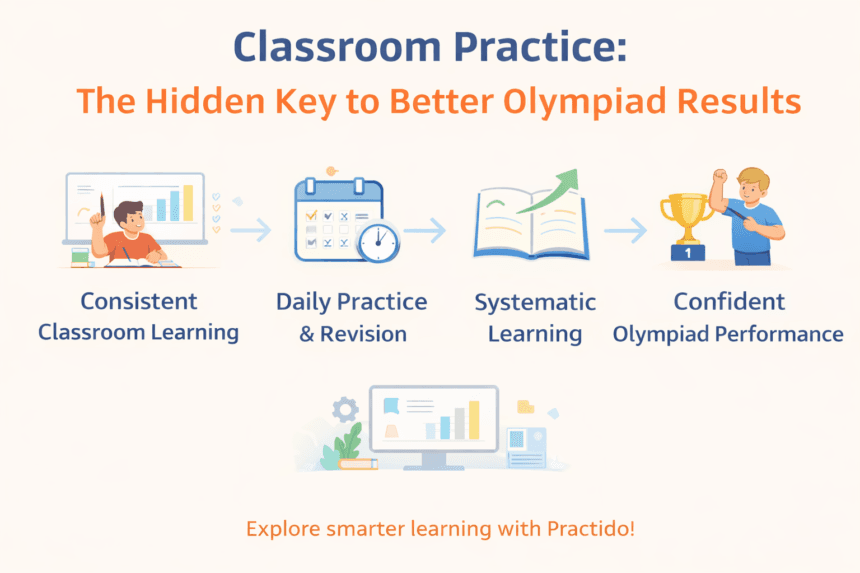
5. From Classroom Learning to Exam Performance
There is a clear connection between classroom effort and exam results.
Here’s how it works:
- Classroom practice builds understanding
- Daily practice improves application
- Structured learning ensures completeness
- Consistency builds confidence
This process creates a strong pathway toward improved Olympiad performance.
6. Smart Revision Strengthens Retention
Even well-understood concepts can fade without revision.
Effective revision strategies include:
- Revisiting weak topics
- Solving mixed-level questions
- Analyzing mistakes
These techniques help students retain information longer and perform better under exam pressure.
7. Early Learning Habits Shape Long-Term Success
Students who develop strong habits early gain a significant advantage.
Good learning habits include:
- Regular study routines
- Time management
- Consistent practice
These habits not only improve Olympiad results but also support overall academic growth.
8. Role of Smart Learning Platforms
While classroom learning is essential, modern tools can enhance its impact.
Digital platforms help students:
- Practice topic-wise questions
- Track performance
- Identify weak areas
Instead of replacing traditional learning, they support it by making practice more structured and accessible.
Conclusion: Success is Built Daily, Not Overnight
Olympiad success is not about shortcuts or last-minute effort. It is the result of consistent classroom practice, structured learning, and disciplined habits.
Students who focus on:
- Regular school practice
- Daily problem-solving
- Smart revision techniques
are naturally better prepared for competitive exams.
The key is simple: learn consistently, practice regularly, and improve steadily.
👉 Explore smarter learning with Practido: https://practido.com
👉 Read more education insights: https://practido.com/blog/olympiad-results-classroom-practice/
👉 Download the Practido App on Google Play & App Store