
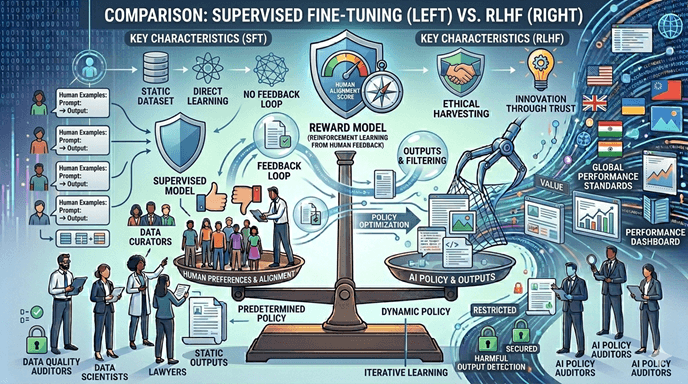

As large language models (LLMs) evolve, the methods used to adapt and align them have become just as important as the models themselves. Two dominant post-training techniques—Supervised Fine-Tuning (SFT) and Reinforcement Learning from Human Feedback (RLHF)—play a central role in shaping how modern AI systems behave. While both approaches aim to improve model performance, they differ fundamentally in methodology, objectives, and outcomes.
For organizations working with a data annotation company or leveraging data annotation outsourcing, understanding these differences is essential. The choice between SFT and RLHF directly impacts not only performance but also alignment, safety, and scalability. This article breaks down these approaches in detail and highlights How High-Quality Training Data Impacts LLM Performance, especially in the context of RLHF Annotation Services.
Understanding Supervised Fine-Tuning (SFT)
Supervised Fine-Tuning is one of the most widely used techniques for adapting pre-trained LLMs to specific tasks. In SFT, models are trained on labeled datasets consisting of input-output pairs, where the “correct” answer is explicitly defined.
This approach works by minimizing prediction error—essentially teaching the model to replicate high-quality human-provided responses.
Key Characteristics of SFT
- Data-driven learning: Relies on structured, labeled datasets.
- Deterministic outcomes: Ideal for tasks with clear correct answers.
- Efficiency: Faster and less computationally intensive than RLHF.
- Task specialization: Strong performance in domains like classification, summarization, and translation.
SFT is often the first step after pretraining because it provides a stable foundation for downstream improvements.
Role of Data Annotation in SFT
The effectiveness of SFT depends heavily on the quality of labeled data. Poor annotations can lead to incorrect generalizations, while high-quality annotations significantly improve accuracy and consistency. This is where a specialized data annotation company becomes critical—ensuring datasets are clean, consistent, and domain-relevant.
Understanding Reinforcement Learning from Human Feedback (RLHF)
RLHF takes model refinement a step further by introducing human feedback as a training signal. Instead of learning from fixed answers, the model learns from preferences, rankings, or ratings provided by human evaluators.
In RLHF, a reward model is trained to capture human preferences, and the LLM is optimized to maximize this reward through reinforcement learning.
Key Characteristics of RLHF
- Preference-based learning: Focuses on what humans prefer, not just what is “correct.”
- Iterative optimization: Involves cycles of feedback, reward modeling, and policy updates.
- Alignment-focused: Enhances safety, tone, and contextual appropriateness.
- Complex pipeline: Requires additional infrastructure and human-in-the-loop processes.
Unlike SFT, RLHF is particularly effective for ambiguous or subjective tasks, such as conversational AI, ethical reasoning, and content moderation.
Role of RLHF Annotation Services
High-quality RLHF Annotation Services are essential for success. Annotators must evaluate outputs based on subtle criteria like helpfulness, harmlessness, and relevance. This makes RLHF more resource-intensive but also more powerful for alignment.
Core Differences Between RLHF and SFT
Although both techniques aim to improve LLM behavior, their differences are substantial and influence when and how each should be used.
1. Training Objective
- SFT: Minimizes error between predicted and labeled outputs.
- RLHF: Maximizes a reward signal based on human preferences.
In simple terms, SFT teaches models what to say, while RLHF teaches them how to behave.
2. Type of Data Used
- SFT: Requires structured, labeled input-output pairs.
- RLHF: Uses human feedback such as rankings, comparisons, or scores.
This distinction highlights How High-Quality Training Data Impacts LLM Performance—both methods depend on data quality, but RLHF adds another layer of complexity through subjective human judgment.
3. Complexity and Cost
- SFT: Straightforward and cost-effective.
- RLHF: More complex, requiring reward models and iterative training loops.
RLHF typically demands more resources, including skilled annotators and advanced infrastructure.
4. Task Suitability
- SFT: Best for well-defined, rule-based tasks.
- RLHF: Ideal for open-ended, nuanced, or subjective tasks.
For example, SFT excels in structured workflows like data extraction, while RLHF is better suited for conversational agents.
5. Model Behavior and Alignment
- SFT: Provides direct supervision but limited behavioral nuance.
- RLHF: Enables fine-grained alignment with human values and expectations.
This makes RLHF essential for building responsible AI systems that interact safely with users.
6. Generalization vs Precision
- SFT: High precision on known tasks but may struggle with unseen scenarios.
- RLHF: Better adaptability to new contexts due to reward-driven learning.
However, RLHF may reduce output diversity and introduce training instability if not carefully managed.
Strengths and Limitations
Advantages of SFT
- Simpler implementation
- Lower cost and faster training
- High accuracy for structured tasks
- Easier to scale with data annotation outsourcing
Limitations of SFT
- Limited ability to handle ambiguity
- Struggles with alignment and safety nuances
- Depends heavily on exhaustive labeled datasets
Advantages of RLHF
- Strong alignment with human preferences
- Improved safety and ethical behavior
- Better handling of complex, subjective tasks
Limitations of RLHF
- High cost and complexity
- Requires continuous human feedback
- Risk of bias in reward models
The Hybrid Approach: Best of Both Worlds
In practice, leading AI systems rarely choose between SFT and RLHF—they combine them.
A typical pipeline looks like this:
- Supervised Fine-Tuning: Establishes baseline performance using labeled data.
- RLHF: Refines outputs to align with human expectations and safety requirements.
This hybrid approach leverages the strengths of both methods, ensuring both accuracy and alignment.
For organizations, this underscores the importance of working with a reliable data annotation company that can support both structured labeling and nuanced feedback collection.
How High-Quality Training Data Impacts LLM Performance
Regardless of the method, data quality remains the single most critical factor.
- In SFT, poor labels lead to incorrect predictions.
- In RLHF, inconsistent feedback results in flawed reward models.
High-quality datasets improve:
- Model accuracy
- Generalization
- Safety and alignment
- User trust
This is why data annotation outsourcing has become a strategic decision rather than just an operational one. Specialized providers like Annotera ensure consistent, scalable, and high-quality data pipelines.
When Should You Choose SFT vs RLHF?
Choose SFT if:
- Your task has clear, objective outputs
- You have access to high-quality labeled datasets
- You need faster deployment and lower costs
Choose RLHF if:
- Your application involves subjective or open-ended outputs
- Alignment, safety, and user experience are critical
- You can invest in RLHF Annotation Services
Choose Both if:
- You are building production-grade AI systems
- You need both accuracy and alignment
Conclusion
Supervised Fine-Tuning and Reinforcement Learning from Human Feedback are not competing approaches—they are complementary tools in modern AI development. SFT provides the structured foundation needed for task performance, while RLHF ensures that models behave in ways that align with human expectations.
For organizations aiming to build high-performing, responsible AI systems, the real differentiator lies in execution—particularly in data quality. Partnering with a trusted data annotation company like Annotera ensures access to high-quality labeled datasets and scalable RLHF Annotation Services, enabling robust and aligned AI systems.
As LLMs continue to advance, the integration of SFT and RLHF will remain central to unlocking their full potential—delivering models that are not only intelligent but also safe, reliable, and human-centric.
- Understanding Supervised Fine-Tuning (SFT)
- Understanding Reinforcement Learning from Human Feedback (RLHF)
- Core Differences Between RLHF and SFT
- 1. Training Objective
- 2. Type of Data Used
- 3. Complexity and Cost
- 4. Task Suitability
- 5. Model Behavior and Alignment
- 6. Generalization vs Precision
- Strengths and Limitations
- The Hybrid Approach: Best of Both Worlds
- How High-Quality Training Data Impacts LLM Performance
- When Should You Choose SFT vs RLHF?
- Conclusion