
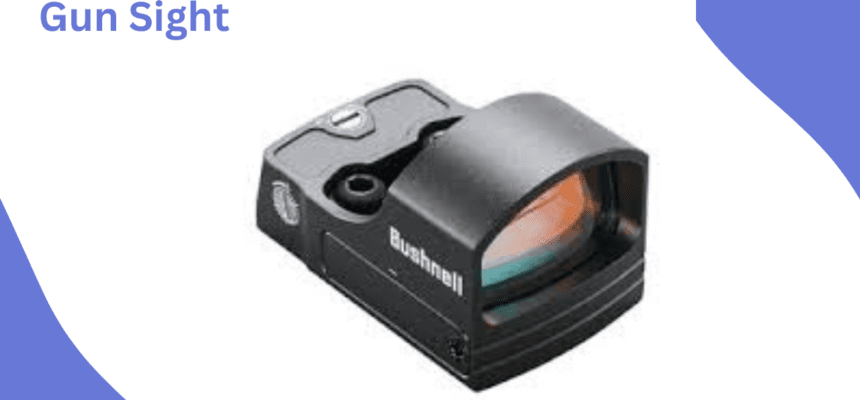
For B2B procurement and industrial manufacturing, the “gun sight” is not merely an accessory; it is a complex optoelectronic assembly where minute tolerances dictate mission success. The industry has moved past basic reflex designs, yet many high-volume models still suffer from significant Parallax Error and Thermal Diode Sensitivity, which can lead to catastrophic accuracy degradation in professional applications.
1. Solving the Parallax Geometry Conflict
In many standard-grade sights, the reticle appears to shift relative to the target when the user’s eye moves off-center. This is a fundamental failure of the aspheric lens curvature.
The Problem: Lower-tier sights utilize spherical lenses that create focal plane discrepancies.
The Technical Solution: Implementing precision-ground aspheric objective lenses ensures that the reflected light from the LED remains parallel across the entire surface of the glass. For manufacturers, this requires shifting from standard molding processes to CNC-controlled optical grinding to achieve a “true zero” parallax at distances beyond 30 meters.
2. Managing Thermal Drift in Laser Diodes
A recurring issue in professional-grade optics is the shifting of the Point of Impact (POI) during rapid temperature fluctuations.
The Problem: The laser diode housing often expands at a different rate than the optical bench, causing the diode to physically tilt by fractions of a millimeter.
The Technical Solution: Utilizing Invar or specialized aerospace-grade aluminum alloys for the diode sub-housing. These materials possess a low coefficient of thermal expansion (CTE), ensuring that the beam divergence remains constant whether the unit is deployed in sub-zero environments or high-heat desert operations.
3. Surface Durability and Light Transmission Optimization
Traditional coatings often fail under the chemical exposure typical in industrial or tactical maintenance.
The Problem: Abrasion and chemical degradation of anti-reflective (AR) coatings, leading to “ghosting” or halo effects in low-light environments.
The Technical Solution: The application of Ion-Assisted Deposition (IAD) for multi-layer coatings. This process creates a denser, more resilient film on the glass substrate, increasing light transmission to >98% while remaining impervious to salt spray, oils, and abrasive dust.
Strategic Procurement & Manufacturing
When evaluating gun sight components for B2B distribution or integration, focus must shift from “features” to structural reliability. Ensuring that the internal circuitry is potted in high-grade epoxy and that the optical path is nitrogen-purged are no longer optional—they are the baseline for professional-tier reliability.
At the manufacturing level, solving these specific optical hurdles is what separates a high-turnover consumer product from a dependable industrial-grade tool.