
For fleet managers and industrial maintenance engineers, a timing belt failure isn’t just a mechanical mishap—it is a high-stakes financial disaster. When a belt snaps in an interference engine, the synchronization between the crankshaft and camshaft vanishes instantly, leading to piston-to-valve contact. The result is a shredded cylinder head, bent valves, and thousands of dollars in unscheduled downtime. Relying on visual inspections alone is a gamble that professional operations cannot afford to take.
The Hidden Physics of Timing Belt Decay
While many maintenance manuals suggest broad replacement intervals, these figures often fail to account for the specific environmental stressors of heavy-duty applications. In B2B sectors—ranging from delivery fleets to stationary industrial engines—thermal cycling and debris ingress accelerate material fatigue.
Standard chloroprene belts may suffice for consumer vehicles, but industrial environments often require Highly Saturated Nitrile (HSN) or EPDM compounds. These materials offer superior resistance to oil, chemicals, and temperatures exceeding 120°C. However, the belt is rarely the sole point of failure. Modern drivetrain forensics show that seized idler pulleys or a failing water pump bearing are often the “silent killers” that melt the belt through friction-induced heat before the belt reaches its theoretical end-of-life.
The Integrated Solution: Beyond the Single Belt
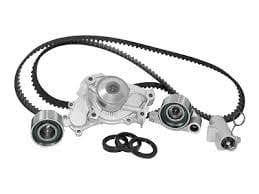
The most feasible solution to prevent drivetrain catastrophe is the transition from “component replacement” to “systemic overhaul” using comprehensive timing belt kits. Replacing only the belt while leaving a 100,000-mile tensioner in place is a critical error.
NMR Bearing specializes in these integrated kits, ensuring that every rotating component within the timing drive shares the same duty cycle. A professional-grade kit must include:
The Timing Belt: Precision-toothed profiles (like Curvilinear or Modified Curvilinear) to ensure maximum surface contact and torque transfer.
Automatic Tensioners: These compensate for belt stretch and thermal expansion, maintaining the exact Newtons of force required to prevent “tooth jump.”
Idler Pulleys and Dampers: High-grade steel or reinforced plastic pulleys that house premium-sealed bearings to prevent vibration-induced wear.
Technical Implementation: Ensuring Long-Term Reliability
For a solution to be valuable, it must be executable. When installing a timing belt kit, precision is the difference between a 10-year lifespan and a 10-minute failure.
Synchronization Accuracy: Utilizing OEM-specific locking tools is mandatory. Even a single tooth offset can cause “hunting” in the engine timing, leading to reduced fuel efficiency and increased emissions, which impacts the bottom line of large-scale operations.
Torque-to-Yield Specs: Most idler bolts are designed for single-use. Reusing old hardware risks bolt fatigue and eventual shearing under the high-vibration environment of an industrial engine.
The Water Pump Factor: In many engine designs, the timing belt drives the water pump. A feasible maintenance strategy dictates replacing the pump simultaneously. If the pump leaks later, the coolant will contaminate the new belt, causing the rubber to swell and fail prematurely.
Meeting 2026 Standards: Data-Driven Maintenance
As we move further into 2026, the industry is shifting toward Predictive Maintenance (PdM). Integrating timing belt kit replacements with vibration analysis and thermal imaging can identify a bearing failure before it manifests as a noise. However, even with advanced monitoring, the physical replacement remains the only “hard” solution to mechanical fatigue.
By choosing kits that meet or exceed ISO/TS 16949 standards, businesses ensure that their hardware can withstand the rigors of modern high-torque engines. Quality kits provide a documented trail of reliability, which is essential for liability and operational continuity in B2B sectors.
Conclusion
Optimizing your drivetrain’s lifespan requires moving away from reactive “fix-it-when-it-breaks” mentalities. A timing belt kit is not just a collection of parts; it is an engineered insurance policy against catastrophic engine loss. By investing in high-specification components like those from NMR Bearing and following a holistic replacement protocol—including tensioners, idlers, and water pumps—engineers can guarantee operational uptime and protect their most valuable mechanical assets. Don’t wait for the snap; synchronize your maintenance before the clock runs out.