


Every engineering team has experienced this at least once:
All tests are green. CI/CD passes. Deployment goes live. And within minutes—errors start flooding in.
- The Illusion of “Green Tests”
- Root Cause #1: Over-Simplified Test Data
- Root Cause #2: Mocked Dependencies Hide Failures
- Root Cause #3: Missing Edge Case Coverage
- Root Cause #4: No Production Feedback Loop
- Root Cause #5: Static Test Suites in a Dynamic System
- Root Cause #6: Ignoring Non-Functional Failures
- Root Cause #7: Lack of End-to-End Context
- The Modern Solution: Production-Driven Testing
- How Keploy Changes the Game
- A Better Testing Mindset
- Final Thoughts
If this sounds familiar, the issue isn’t just your code. It’s your API testing strategy.
Most API tests pass in staging but fail in production due to unrealistic test scenarios. Modern systems require more than just mocked responses and static validation.
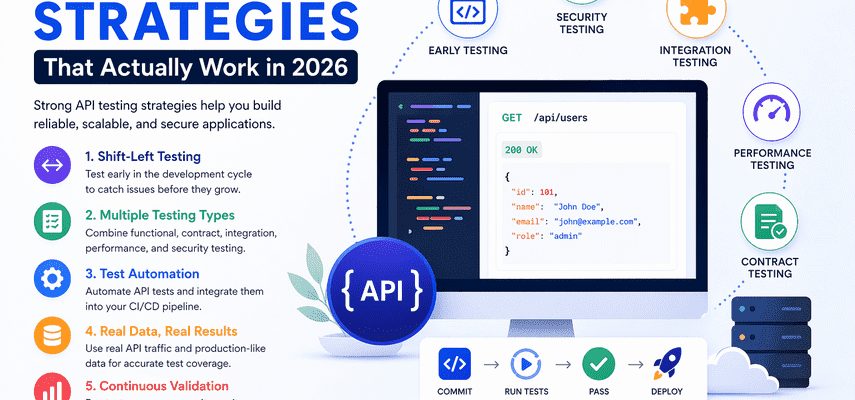
Modern API testing requires real-world validation. This is well explained in this guide on API testing strategies
The Illusion of “Green Tests”
A passing test suite creates confidence—but sometimes false confidence.
Most API tests validate:
Expected inputs
Expected outputs
Ideal conditions
But production is anything but ideal.
Real users:
Send unexpected inputs
Trigger race conditions
Hit edge cases you never imagined
Third-party APIs:
Fail unpredictably
Return malformed data
Experience latency spikes
Your tests pass because they simulate a perfect world. Production fails because it isn’t one.
Root Cause #1: Over-Simplified Test Data
Test environments typically use:
Clean datasets
Predictable values
Controlled scenarios
But production data is messy:
Missing fields
Invalid formats
Unexpected combinations
For example:
An API handling user profiles may pass tests with complete data—but fail when a real user skips optional fields or submits unexpected input.
Fix:
Use real or production-like data in testing.
Better yet, capture real API interactions and reuse them as test cases.
Root Cause #2: Mocked Dependencies Hide Failures
Mocks are designed to simplify testing—but they also hide real problems.
When you mock dependencies:
You control responses
You eliminate failures
You ignore real-world behavior
This creates a dangerous gap between testing and reality.
Fix:
Limit mocks to unit testing
Use real services or recorded responses in integration tests
Simulate failures intentionally
Root Cause #3: Missing Edge Case Coverage
Most teams test:
Happy paths
Common scenarios
But production failures come from:
Rare edge cases
Unexpected inputs
Timing issues
Fix:
Adopt a mindset of:
“What could go wrong?” instead of “What should work?”
Test:
Invalid payloads
Large data volumes
Concurrent requests
Network delays
Root Cause #4: No Production Feedback Loop
Many teams treat testing as a pre-deployment activity.
Once the code is live:
Testing stops
Monitoring starts
But these should be connected.
Fix:
Create a feedback loop:
Capture production issues
Convert them into test cases
Add them to your CI pipeline
This ensures the same bug never reaches production again.
Root Cause #5: Static Test Suites in a Dynamic System
Modern applications change rapidly:
APIs evolve
Schemas update
Dependencies change
But test suites often remain static.
This leads to:
Outdated tests
Missed scenarios
False confidence
Fix:
Use dynamic test generation:
Generate tests from real API traffic
Update tests automatically as APIs evolve
Platforms like Keploy help solve this by:
Recording API calls
Turning them into test cases
Keeping tests in sync with real usage
Root Cause #6: Ignoring Non-Functional Failures
Most API tests focus on correctness:
Status codes
Response bodies
But production failures often involve:
Performance issues
Timeouts
Rate limits
Fix:
Include non-functional testing:
Load testing
Latency validation
Timeout scenarios
Because an API that is “correct but slow” is still broken.
Root Cause #7: Lack of End-to-End Context
APIs rarely operate in isolation.
A single request may involve:
Multiple services
Databases
External APIs
Testing APIs individually doesn’t guarantee system reliability.
Fix:
Add end-to-end API workflows
Validate complete user journeys
Test service interactions, not just endpoints
The Modern Solution: Production-Driven Testing
To truly prevent production failures, testing must evolve.
Modern API testing focuses on:
Real data
Real scenarios
Continuous validation
Instead of writing tests manually, teams are now:
Capturing real API traffic
Replaying it in test environments
Automating validation
This approach ensures your tests reflect how your system is actually used.
How Keploy Changes the Game
Traditional testing requires:
Writing test cases manually
Maintaining them constantly
Updating them with every change
With Keploy:
Tests are generated automatically from API calls
Real data is used instead of synthetic data
Maintenance is minimal
This allows teams to:
Increase coverage without extra effort
Detect real-world bugs early
Build confidence in deployments
A Better Testing Mindset
To fix the gap between testing and production, shift your mindset:
From:
“Did the test pass?”
To:
“Does this reflect real-world behavior?”
From:
“We covered all cases”
To:
“What cases are we missing?”
Final Thoughts
If your APIs are breaking in production despite passing tests, the problem isn’t unusual—it’s systemic.
Modern systems require modern testing strategies.
By:
Using real data
Reducing reliance on mocks
Creating continuous feedback loops
Leveraging tools like Keploy
You can move from reactive debugging to proactive reliability.
Because in 2026, the goal isn’t just to pass tests—
It’s to prevent failures before they happen.