



Modern software development has evolved significantly, with teams shipping faster, collaborating across functions, and building increasingly complex systems.
In this environment, testing is no longer just about catching bugs—it’s about ensuring reliability at speed.
This is where the discussion around TDD vs BDD becomes highly relevant.
Both approaches aim to improve code quality, but they differ in how they guide development and testing practices.
Understanding the Basics
Before comparing the two, it’s important to understand what each approach represents.
Test-Driven Development (TDD)
TDD is a development approach where tests are written before the code itself.
The typical cycle involves:
Writing a failing test
Writing the minimum code to pass the test
Refactoring the code
This process ensures that code is continuously validated as it is developed.
Behavior-Driven Development (BDD)
BDD extends the principles of TDD by focusing on behavior rather than implementation.
It emphasizes:
Writing tests in a human-readable format
Defining expected system behavior
Aligning developers, testers, and stakeholders
BDD scenarios are often written in a way that non-technical team members can understand.
TDD vs BDD: Key Differences
Focus
TDD focuses on verifying code correctness at a technical level.
BDD focuses on validating system behavior from a user or business perspective.
Language and Communication
TDD tests are typically written in code and are primarily understood by developers.
BDD uses natural language constructs, making it easier for cross-functional teams to collaborate.
Scope
TDD operates at a lower level, often targeting individual units or components.
BDD works at a higher level, focusing on user journeys and system behavior.
Purpose
TDD ensures that code works as expected.
BDD ensures that the system behaves as intended.
When to Use TDD
TDD is particularly useful when:
Building core logic or algorithms
Developing complex components
Ensuring code-level correctness
It helps developers:
Catch issues early
Write cleaner, more maintainable code
Reduce debugging effort
TDD is best suited for situations where precision and control are critical.
When to Use BDD
BDD is more effective when:
Defining user-facing features
Aligning technical and non-technical teams
Validating business requirements
It helps teams:
Improve communication
Ensure shared understanding
Focus on delivering value to users
BDD works well in collaborative environments where clarity of behavior is essential.
How TDD and BDD Complement Each Other
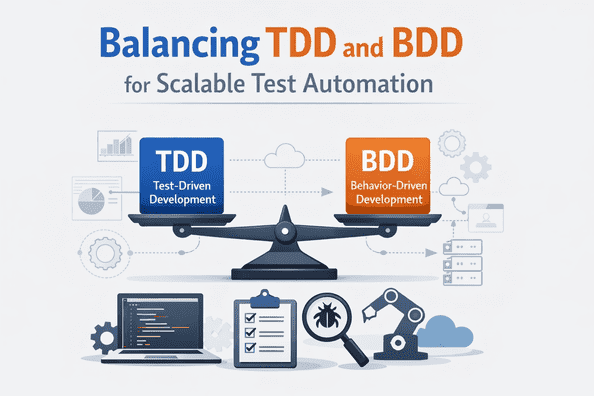
The comparison of TDD vs BDD is often framed as a choice, but in practice, they can work together.
A typical workflow might involve:
Using BDD to define high-level behavior
Using TDD to implement and validate the underlying logic
This combination allows teams to:
Align on requirements
Maintain code quality
Ensure system reliability
Both approaches contribute to effective software testing by addressing different aspects of the development process.
Challenges in Modern Development
Balancing Speed and Quality
Fast-moving teams may struggle to maintain discipline in writing tests before code.
Skipping TDD or BDD practices can lead to:
Increased technical debt
Harder debugging
Reduced confidence in releases
Maintaining Test Relevance
As systems evolve, tests can become outdated.
Both TDD and BDD require:
Continuous updates
Alignment with current system behavior
Regular maintenance
Overcomplicating Test Suites
Excessive or poorly structured tests can slow down development.
Teams need to focus on:
Writing meaningful tests
Avoiding redundancy
Keeping test suites manageable
Choosing the Right Approach
There is no one-size-fits-all answer in the TDD vs BDD debate.
The right choice depends on:
The type of system being built
Team structure and collaboration needs
The level of complexity involved
In many cases, a hybrid approach works best.
Teams can use:
TDD for low-level validation
BDD for high-level behavior
This ensures both technical correctness and business alignment.
The Future of TDD and BDD
As development practices evolve, the principles behind TDD and BDD remain relevant.
Modern tools and workflows may change how tests are written and executed, but the core ideas—early validation and clear definition of behavior—continue to be essential.
Teams that effectively apply these approaches will be better equipped to build reliable systems in fast-paced environments.
Final Thoughts
The discussion around TDD vs BDD is not about choosing one over the other.
It’s about understanding how each approach contributes to building better software.
TDD ensures that code works correctly.
BDD ensures that the system behaves as expected.
Together, they provide a strong foundation for developing reliable, high-quality applications in modern software development.