

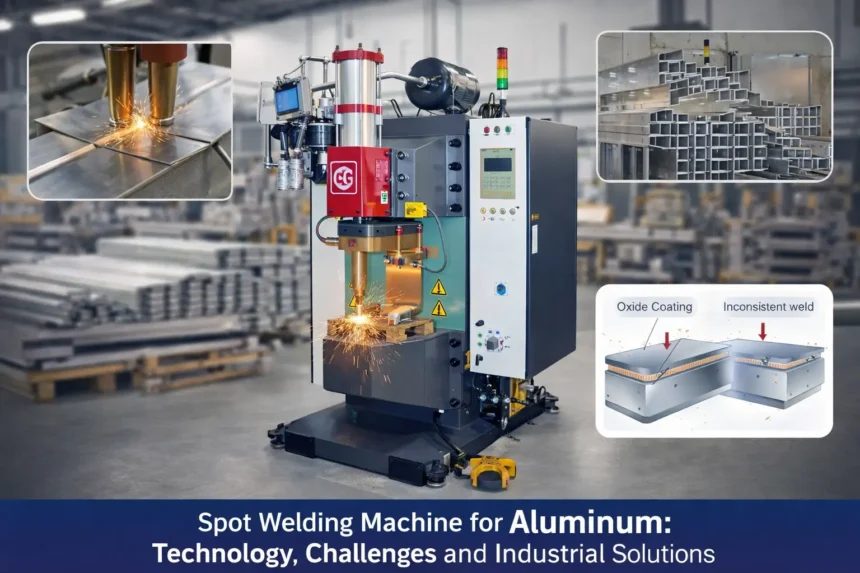

In advanced manufacturing, spot weld aluminium has become a critical capability as industries push for lighter, stronger, and more energy-efficient structures. From electric vehicles and aerospace assemblies to battery trays and high-speed rail components, aluminium is replacing steel at scale.
However, aluminium is not an easy material to join using conventional resistance spot welding (RSW). Its high electrical conductivity, strong oxide layer, and rapid heat dissipation make process control significantly more complex compared to steel welding applications. Industrial studies confirm that improper parameter control can lead to unstable nugget formation and reduced weld reliability in aluminium joints .
For OEMs, automation integrators, and production engineers, understanding how to properly spot weld aluminium is essential for achieving consistent weld quality and high production efficiency.
What Is Spot Welding Aluminium?
Spot welding aluminium is a resistance-based joining process where two or more aluminium sheets are clamped between copper electrodes and joined by passing a high electrical current for a controlled time.
The process relies on three fundamental stages:
1. Heat Generation (Joule Heating)
Electrical resistance at the interface generates heat, melting the aluminium locally.
2. Nugget Formation
The molten zone solidifies under pressure, forming a weld “nugget.”
3. Forge Cooling
Electrode force is maintained during cooling to ensure joint integrity and prevent porosity or expulsion.
Unlike steel, aluminium requires much higher current and shorter weld times to compensate for heat loss and conductivity challenges .
Why Spot Welding Aluminium Is Technically Challenging
From a production engineering perspective, aluminium presents multiple process constraints:
1. High Electrical Conductivity
Aluminium conducts electricity very efficiently, which reduces heat concentration at the weld interface. As a result, significantly higher current is required compared to steel.
2. Oxide Layer Barrier
A naturally forming aluminium oxide layer has a very high melting point, acting as an electrical insulator and interfering with stable nugget formation. Even slight surface variation can cause inconsistent weld quality .
3. Rapid Heat Dissipation
Aluminium quickly dissipates heat, making it difficult to sustain a stable molten weld pool.
4. Electrode Wear
Frequent welding accelerates electrode degradation due to adhesion and surface reaction with aluminium alloys .
These factors combined make process stability the core challenge in aluminium spot welding systems.
Key Process Parameters for Aluminium Spot Welding
For engineers and production managers, controlling parameters is critical for repeatable weld quality.
Welding Current
Aluminium typically requires very high current levels (often 2–3× higher than steel) to generate sufficient heat for nugget formation.
Weld Time
Short cycle times are essential to prevent excessive heat loss and minimize expulsion defects.
Electrode Force
Higher force ensures stable contact resistance and reduces surface variability caused by oxide layers.
Electrode Design
Large-diameter copper electrodes with optimized cooling channels are commonly used to stabilize performance.
Industrial data shows that small deviations in these parameters can significantly affect weld strength and consistency in aluminium assemblies .
MFDC Technology: The Preferred Solution for Spot Weld Aluminium
Modern manufacturing increasingly relies on MFDC (Medium Frequency Direct Current) resistance welding systems for aluminium applications.
Why MFDC Works Better
- Stable DC output (no zero-crossing losses)
- Precise millisecond-level current control
- Higher thermal efficiency
- Reduced spatter and electrode wear
Compared to traditional AC systems, MFDC provides significantly improved control over heat input and weld nugget formation, making it ideal for aluminium production lines.
This is particularly important in high-volume industries like EV battery manufacturing and aerospace structures, where consistency is critical.
Industrial Applications of Spot Weld Aluminium
1. Automotive & Electric Vehicles
Aluminium spot welding is widely used in:
- Battery enclosures
- Lightweight body structures
- Crash-resistant frames
EV manufacturers rely heavily on stable welding processes to ensure structural safety and electrical insulation reliability.
2. Aerospace Manufacturing
Aircraft structures require lightweight yet high-strength joints, making aluminium spot welding a key joining method for fuselage panels and interior components.
3. Rail Transportation
High-speed rail systems use aluminium for energy efficiency and corrosion resistance, requiring precision spot welding for structural panels.
4. Industrial Equipment & Enclosures
Control cabinets, machine housings, and industrial frames frequently use aluminium spot welding for durability and reduced weight.
Best Practices for Stable Aluminium Spot Welding
To achieve industrial-grade weld consistency, engineers should follow these best practices:
Surface Preparation
Proper cleaning and oxide control are essential before welding. Even minor contamination can significantly affect weld quality.
Parameter Optimization
Each aluminium alloy requires customized welding schedules based on thickness, conductivity, and application.
Electrode Maintenance
Regular dressing and cooling system checks help maintain consistent contact quality.
Process Monitoring
Advanced systems now integrate real-time monitoring of current, voltage, and displacement to ensure weld integrity.
Heron Welder: Industrial Expertise in Aluminium Spot Welding Solutions
At Heron Welder, aluminium spot welding is not treated as a generic process—it is engineered as a precision manufacturing solution.
With decades of expertise in:
- Resistance spot welding systems (AC, MFDC, capacitor discharge)
- Automated welding production lines
- Clinching and self-pierce riveting (FSPR)
- Custom welding guns and controllers
Heron delivers turnkey aluminium joining solutions for high-volume production environments.
From EV body-in-white assembly to industrial automation lines, Heron systems are designed to ensure:
- Stable aluminium weld quality
- Reduced electrode wear
- High-speed production efficiency
- Fully integrated automation control
FAQs: Spot Weld Aluminium
1. Can aluminium be spot welded like steel?
Yes, but it requires significantly higher current, precise control, and MFDC-based systems due to aluminium’s conductivity and oxide layer.
2. Why is aluminium difficult to spot weld?
Because of its high thermal conductivity, oxide insulation layer, and rapid heat loss, which make stable nugget formation more challenging.
3. What industries commonly use aluminium spot welding?
Automotive (EVs), aerospace, rail transport, and industrial equipment manufacturing.
4. What is the best welding technology for aluminium spot welding?
MFDC resistance spot welding is currently the most efficient and stable method for industrial applications.
5. How can weld quality be improved in aluminium spot welding?
By optimizing current, reducing weld time, maintaining electrode condition, and using advanced process monitoring systems.
Conclusion: Achieving Reliable Aluminium Spot Welds at Scale
Spot welding aluminium is no longer just a material challenge it is a process engineering discipline requiring precision, control, and advanced technology. As industries shift toward lightweight materials, demand for reliable aluminium joining solutions continues to grow.
With the right combination of MFDC technology, optimized parameters, and automated control systems, manufacturers can achieve consistent, high-strength aluminium welds at scale.
Partner with Heron for Advanced Aluminium Welding Solutions
If you are looking to improve aluminium spot welding performance, reduce production defects, or develop a fully automated welding line, Heron Welder provides customized engineering solutions tailored to your manufacturing needs.
Contact Heron today to request a consultation or quotation for your next aluminium welding automation project.