

Step inside any modern food manufacturing facility and you will immediately notice one thing — product is always moving. From the moment raw ingredients arrive at the intake bay to the point finished goods leave the packaging line, material is in continuous motion. The system responsible for keeping that flow efficient, hygienic, and uninterrupted is the conveyor machine. Far from being a single piece of equipment, conveyors come in a wide range of types, each engineered for a specific material, environment, and stage of the production process. Understanding which type suits your facility is one of the most impactful decisions you will make when designing or upgrading a food processing line in Pakistan or South Asia.
What is a Conveyor Machine?
A conveyor machine is a mechanical material handling system that transports products, ingredients, or bulk materials from one point to another within a production or processing facility — automatically, continuously, and with minimal manual intervention.
In food processing, conveyor machines must do more than simply move product. They must do so without contaminating it, without damaging its structure or packaging, and in compliance with the hygiene standards required at each stage of food production. This is why food-grade conveyors are built from specific materials — primarily stainless steel and food-approved plastics — and designed with sanitation in mind. The choice of conveyor type directly affects your line speed, product integrity, hygiene compliance, and operational efficiency.
Key Features & Benefits
Regardless of type, a well-specified food processing conveyor machine delivers a consistent set of operational advantages:
- Automated Continuous Flow: Conveyors eliminate the need for manual product transfer between production stages, reducing labour costs, minimising handling damage, and maintaining consistent throughput rates across the entire line.
- Hygienic Design Compliance: Food-grade conveyor machines are built with smooth, crevice-free surfaces, sloped frames for drainage, and tool-free disassembly features that make cleaning and sanitisation faster, more thorough, and fully auditable.
- Flexible Layout Integration: Modern conveyors are modular and configurable — they can run horizontally, at inclines, around corners, or vertically — allowing them to fit within virtually any production floor layout without major structural changes.
- Reduced Product Damage: Correctly matched conveyor types handle fragile, sticky, hot, or irregularly shaped food products gently and consistently, reducing breakage, deformation, and wastage across the line.
- Scalability and Speed Control: Variable speed drives allow conveyor machines to synchronise with upstream and downstream equipment, preventing bottlenecks, reducing product queuing, and enabling smooth line balancing as production volumes change.
Industrial Applications
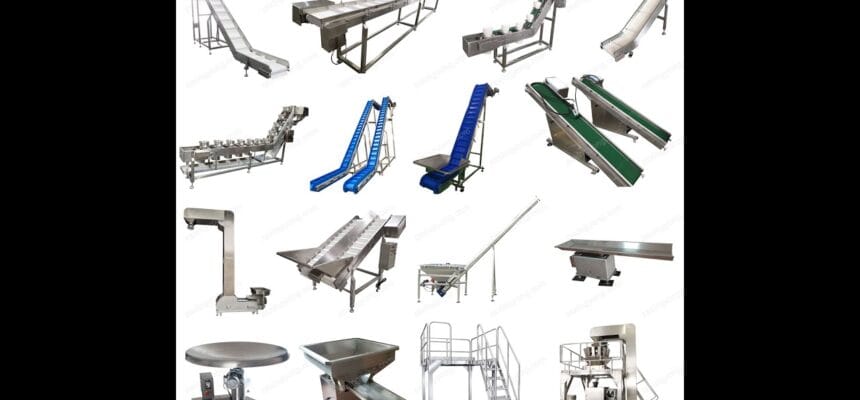
Different types of conveyor machines serve different functions across Pakistan’s food and beverage processing industry. Here is a breakdown of the most widely used types and where they are applied:
Belt Conveyors are the most common type in food processing, used to transport packaged goods, fresh produce, baked products, and processed snacks along horizontal or gently inclined paths. Flat belt conveyors are ideal for stable, packaged products, while textured or chevron belt designs handle loose bulk items and inclined transfers without slippage.
Screw Conveyors are enclosed helical systems used to move dry powders, granules, and semi-moist materials — such as flour, spices, sugar, and feed ingredients — between hoppers, mixers, and packaging stations in a contained, dust-free manner.
Bucket Elevators vertically lift bulk granular or powder materials — grain, salt, pellets, and similar products — to height in continuous bucket chains, bridging floor-level intake points with elevated hoppers or processing equipment above.
Vibrating Conveyors use controlled oscillation to move fragile, sticky, or temperature-sensitive food products — such as freshly fried snacks, coated nuts, or frozen items — gently along a trough without the product tumbling or breaking.
Roller Conveyors support and transport heavy cartons, crates, and palletised goods across flat surfaces in warehousing, dispatch, and finished goods areas, providing low-friction, gravity-assisted movement for large packaged loads.
Slat and Modular Plastic Conveyors are widely used in meat, poultry, and seafood processing where washdown conditions are frequent and aggressive cleaning chemicals are used — their open structure and chemical-resistant materials allow thorough sanitation with minimal disassembly.
How to Choose the Right One
Selecting the correct conveyor machine for your food processing application requires matching equipment characteristics precisely to your product and operational requirements:
- Start with Your Product’s Properties: Weight, fragility, shape, temperature, moisture content, and stickiness all determine which conveyor type and belt or trough material is appropriate. A conveyor that works perfectly for dry biscuits will be wholly unsuitable for fresh meat or wet vegetable pieces.
- Define the Transfer Path: Horizontal runs, inclines, elevation changes, and directional turns each favour different conveyor designs. Map the full material path from intake to output before specifying any equipment.
- Set Your Throughput Requirements: Calculate peak hourly capacity in kilograms or units per minute. This determines belt width, conveyor speed, and motor sizing — all of which must be matched to your fastest production stage to avoid bottlenecks.
- Prioritise Washdown and Sanitation Design: In any food contact environment, confirm that the conveyor meets hygiene design standards — stainless steel frames, IP-rated motors, quick-release belt tensioning, and open leg designs that allow floor cleaning underneath.
- Consider the Full Line, Not Just One Section: Conveyors work best when specified as an integrated system. Mismatched speeds, heights, or widths between adjacent conveyors create transfer problems that slow the entire line. Plan holistically from the start.
Why Quality Matters
A conveyor machine in a food processing plant runs for multiple shifts every day, carrying product that will be consumed by the public. In this context, build quality is simultaneously a production issue, a hygiene issue, and a safety issue.
Cheaply built conveyors develop belt tracking problems, frame vibrations, and motor failures that interrupt production and require constant attention from maintenance teams. Worse, poorly finished welds, exposed hollow frame sections, and inadequate belt tensioning systems become chronic contamination points that survive routine cleaning — invisible to inspection but active during production.
For food manufacturers competing in Pakistan’s modern retail and export environment, where supplier audits increasingly include equipment hygiene assessments, the build quality of your conveyor infrastructure is part of your compliance story. Investing in well-engineered, food-grade conveyor machines from the outset is far less costly than retrofitting hygiene improvements after a failed audit or a product contamination incident.
Conclusion
The right conveyor machine is not a single product — it is a carefully selected combination of technologies matched to your specific materials, production layout, hygiene requirements, and throughput targets. Whether you are building a new food processing line from the ground up or upgrading sections of an existing facility, getting conveyor specification right is one of the highest-leverage decisions in your plant design. For food processing businesses exploring durable, hygienically designed solutions built for Pakistani industrial conditions, you can review detailed specifications and configuration options for a reliable Conveyor Machine to find the right fit for your production environment.