

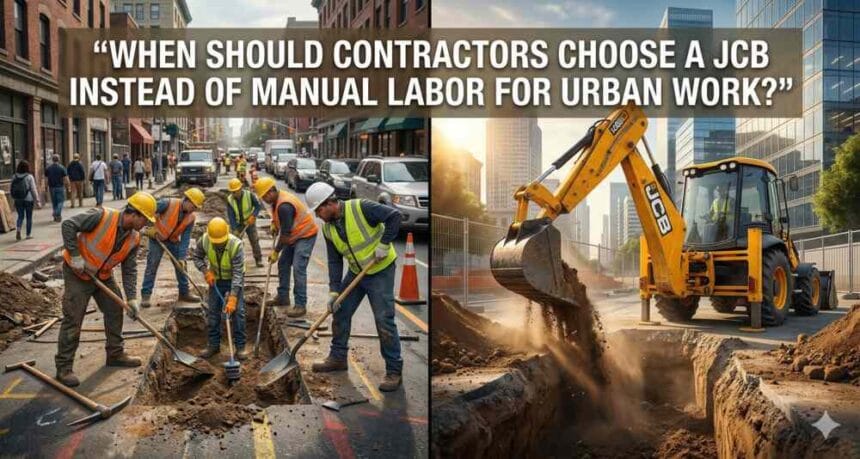

Key Takeaways
• A JCB is ideal for large excavation work in urban construction projects.
• Machines help contractors meet tight construction deadlines.
• JCB equipment handles heavy materials faster than manual labor.
• Road repair and utility trench work become quicker with machine digging.
• Demolition and debris removal are much faster with construction machines.
• JCB use helps manage labor shortages on construction sites.
• Modern machines can operate in compact urban construction areas.
• Machine digging provides more consistent depth and accuracy.
• Using equipment reduces physical strain and safety risks for workers.
• Faster completion often reduces overall project cost for contractors.
- Key Takeaways
- People also search for answers to practical questions –
- Why Choosing a JCB for Urban Construction Work Is Important for You?
- Large Volume Excavation Work
- Tight Construction Deadlines
- Handling Heavy Construction Materials
- Road Repair and Utility Line Work
- Demolition and Debris Removal
- Limited Workforce Availability
- Working in Restricted Urban Spaces
- Projects That Require Consistent Precision
- Reducing Physical Risk for Workers
- Last Thoughts
Have you noticed how construction work in busy cities is changing so fast? Many contractors now ask a simple question. Should this work be done by laborers or by a machine like a JCB?
Urban construction brings many challenges. Roads are narrow. Time is limited. Traffic never really stops. In such conditions contractors often wonder when it makes sense to bring in a JCB instead of relying only on manual labor.
People also search for answers to practical questions –
When is a JCB actually useful in city construction work? Is it faster than manual labor? Does it reduce project time? Can it handle tight urban spaces? And is it really worth the cost?
To understand this clearly, we need to look at how both methods work.
Manual labor depends on workers using tools and physical effort.
A JCB on the other hand is a heavy construction machine designed to dig lift move and clear material quickly.
The real question is not which one is better. The real question is when a JCB becomes the smarter choice for urban work.
This article by a JCB wheeled loader dealer in Faridabad explains the situations where contractors should choose a JCB and why it makes sense.
Why Choosing a JCB for Urban Construction Work Is Important for You?
Urban construction projects often run under strict timelines. Delays can increase costs and cause problems with traffic authorities and nearby residents.
When contractors choose the right method for the job, they save time and reduce unnecessary effort.
The choice also affects safety and efficiency. Heavy digging lifting or debris removal can be risky for workers.
For contractors the decision is not just about speed. It is about choosing the most practical method for the situation.
Situations When Contractors Should Use a JCB Instead of Manual Labor in Urban Work
Large Volume Excavation Work
Excavation is one of the most common tasks in construction. Digging foundations or trenches manually takes a lot of time and manpower.
A JCB can dig large areas quickly and with consistent depth. This makes it ideal for projects where a large volume of soil must be removed.
In urban projects where time matters this speed helps contractors stay on schedule.
Tight Construction Deadlines
City construction projects often come with strict deadlines. Roads may be blocked only for a limited time. Work permits may allow construction only during certain hours.
Manual labor simply cannot match the speed of a construction machine.
It can complete digging loading and clearing tasks in hours that might otherwise take days.
Handling Heavy Construction Materials
Urban construction sites often deal with heavy materials like soil concrete debris and stones.
Moving such materials manually requires many workers and still takes time.
It can lift and move heavy loads easily. This reduces physical strain on workers and speeds up the work process.
Road Repair and Utility Line Work
Many urban projects involve repairing roads or installing pipelines water lines and cables.
These jobs require quick trench digging and fast filling once the work is complete.
Using manual labor for this process slows everything down. It can dig precise trenches and close them quickly which helps reduce traffic disruption.
Demolition and Debris Removal
Small building demolition and debris removal are common in city redevelopment projects.
Manual removal of broken concrete bricks and rubble is slow and exhausting for workers.
It can break remove and load debris much faster. This helps clear the site quickly so the next phase of construction can begin.
Limited Workforce Availability
Construction projects sometimes face labor shortages. Workers may not always be available when needed.
Machines help fill this gap.
One JCB operator can complete the work that might normally require several laborers. This makes project planning more reliable.
Working in Restricted Urban Spaces
Many people assume machines cannot work in narrow urban areas. But modern JCB machines are designed to operate in compact construction sites.
Their maneuverability allows them to work efficiently even in tight locations.
For contractors this means machines can still be useful even in crowded city environments.
Projects That Require Consistent Precision
Manual digging often results in uneven surfaces or inconsistent trench depth.
Construction machines can provide more consistent results.
It allows operators to control digging depth and material movement accurately which improves construction quality.
Reducing Physical Risk for Workers
Construction work can be physically demanding and sometimes dangerous.
Tasks like deep digging lifting heavy debris or breaking concrete increase the risk of injury.
Using this by JCB telescopic handlers dealers in Palwal allows workers to operate machinery instead of performing heavy manual tasks. This improves safety on the site.
Last Thoughts
Urban construction projects demand speed efficiency and careful planning. Contractors must choose the method that best fits the situation. Manual labor still plays an important role in many small or detailed tasks. But when the work involves heavy excavation debris removal or strict deadlines machines like a JCB can make the job far easier.