

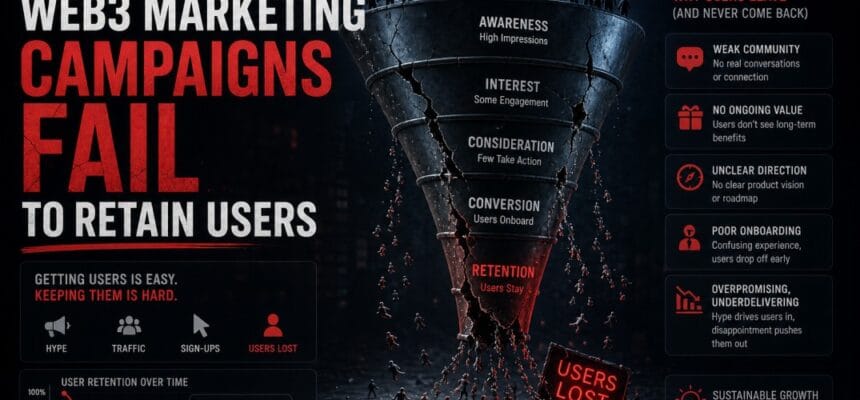

Web3 marketing campaigns are exceptionally good at one thing: generating first-time attention. A well-funded KOL campaign, a viral Twitter thread, a high-profile launchpad listing, or a Discord giveaway can bring thousands of new users into a project’s orbit in a matter of days.
- Why Do Web3 Marketing Campaigns Fail to Retain Users?
- Reason 1: The Campaign Attracts the Wrong Audience
- Reason 2: There is No Onboarding Experience After Acquisition
- Reason 3: Marketing Stops at Launch
- Reason 4: The Community Has No Identity or Culture
- Reason 5: Retention Metrics Are Not Being Tracked
- Reason 6: Product and Marketing Are Not Aligned
- What a Retention-Focused Web3 Marketing Strategy Looks Like
- Conclusion
What those same campaigns are notoriously bad at is keeping those users engaged after the initial excitement fades. Community member counts spike and then slowly bleed out. Token holders dump at the first opportunity. Discord activity collapses two weeks after a launch campaign. The project’s growth chart looks like a series of spikes separated by valleys, never a sustained curve upward.
This retention failure is not random. It has specific causes, and most of them are preventable with the right marketing structure. This post diagnoses the most common reasons Web3 marketing campaigns fail to retain users and explains what needs to change.
Why Do Web3 Marketing Campaigns Fail to Retain Users?
Web3 marketing campaigns fail to retain users primarily because they are designed around acquisition metrics rather than activation and retention outcomes. Campaigns optimized for reach, impressions, and new member counts attract users who joined for the attention moment not for the underlying product or community. Without a structured post-acquisition experience that builds genuine engagement and product value, most of these users disengage within days of joining.
Reason 1: The Campaign Attracts the Wrong Audience
Many Web3 marketing campaigns are structured around maximum reach rather than audience quality. Giveaways attract reward hunters. Generic KOL campaigns with broad audiences bring in passive crypto spectators who have no particular interest in the project’s actual use case. Airdrop campaigns attract wallet farmers who will dump immediately when tokens vest.
When the acquisition channel is misaligned with the project’s genuine value proposition, the users who arrive have no foundation for staying. They came for the incentive, not the product. When the incentive is gone, so are they.
The fix is not to stop running acquisition campaigns it is to run them with tighter audience targeting and to pair them with qualification steps that filter for genuine interest rather than incentive seekers.
Reason 2: There is No Onboarding Experience After Acquisition
The vast majority of Web3 marketing budgets go toward getting users to a Discord server, a website, or a token. Almost no budget goes toward what happens next. A new member who joins a Discord server and receives no welcome, no guidance, and no clear path to engagement will lurk briefly and leave.
Onboarding is a distinct stage of the user journey that requires its own investment and design. It means welcome sequences that orient new members, human moderators who respond to new joiners, educational content that builds product understanding, and guided first steps that lower the barrier to meaningful engagement.
Projects that build structured onboarding programs consistently see higher retention rates from the same acquisition campaigns. The acquisition budget is not wasted the onboarding infrastructure captures the value that would otherwise drain away.
Reason 3: Marketing Stops at Launch
One of the most predictable retention killers in Web3 is the marketing cliff. Teams pour resources into pre-launch and launch campaigns and then scale marketing back dramatically once the token is live. The logic seems reasonable the launch is done, now we focus on product. But from the community’s perspective, the silence feels like abandonment.
Retention requires a continuous reason to stay. Regular content, consistent community events, ongoing product updates shared with the community, and sustained social media presence all communicate that the project is alive and progressing. The projects that maintain marketing activity through the bear phases of their token’s cycle are the ones that still have communities when the market turns.
Reason 4: The Community Has No Identity or Culture
Communities that survive market downturns almost always have one thing in common: a strong shared identity. Members feel like they belong to something beyond just a token investment. Whether that is a shared belief in the technology, a specific community culture, an ongoing narrative that members participate in, or a sense of collective ownership identity creates bonds that price action cannot break.
Most marketing campaigns do not build identity. They build awareness. Awareness fades. Identity endures. The marketing approach that builds identity is long-form storytelling, genuine team transparency, community co-creation of lore and culture, and treating members as stakeholders rather than audience members.
Reason 5: Retention Metrics Are Not Being Tracked
You cannot improve what you are not measuring. Most Web3 marketing teams track acquisition metrics obsessively and retention metrics rarely or never. They know how many people joined last week but not how many of last month’s new members are still active. They know their total Discord member count but not their daily active user ratio or their 30-day retention curve.
When retention is not measured, there is no feedback signal to improve it. Adding retention tracking as a standard part of marketing reporting even simple metrics like DAU to total member ratio, weekly active community members, and 30-day engagement curves creates the visibility needed to diagnose and fix dropout points.
Reason 6: Product and Marketing Are Not Aligned
Sometimes the retention failure is not a marketing problem at all. When marketing campaigns create expectations that the product does not meet when KOL content oversells features that are not yet built, when community growth happens faster than the product can support, when onboarding promises an experience that reality cannot deliver retention fails because of the gap between what was marketed and what was experienced.
The fix is closer coordination between marketing and product teams. Marketing timelines should align with product readiness. Campaign promises should reflect actual current capabilities. Community expectations should be set honestly, because an audience that understands and accepts a project’s current stage will forgive limitations that an audience led to believe the product was further along will not.
What a Retention-Focused Web3 Marketing Strategy Looks Like
A marketing strategy built around retention looks different from one built around acquisition. It starts campaigns earlier and runs them longer. It invests in onboarding infrastructure before scaling acquisition spend. It measures engagement quality alongside member count. It publishes consistent content through market cycles, not just during hype windows. And it treats community culture as a marketing asset, not an afterthought.
The agencies and in-house teams that build retention into their marketing strategy from the beginning build projects that compound over time rather than spike and fade. In Web3, where trust is the scarcest resource and community loyalty is the hardest thing to earn, retention is not just a metric it is the clearest signal that the marketing is actually working.
Conclusion
Retention failure in Web3 marketing is almost always a structural problem, not a budget problem. The root causes wrong audience targeting, missing onboarding, post-launch marketing cliffs, absence of community identity, and no retention metrics are all solvable with the right approach.
The projects that build lasting communities are not always the ones with the biggest marketing budgets. They are the ones that treat user retention as a first-class marketing objective and design their entire strategy around keeping the users they work so hard to acquire.