


B2B Customer Onboarding Best Practices: How to Turn New Clients into Long-Term Partners
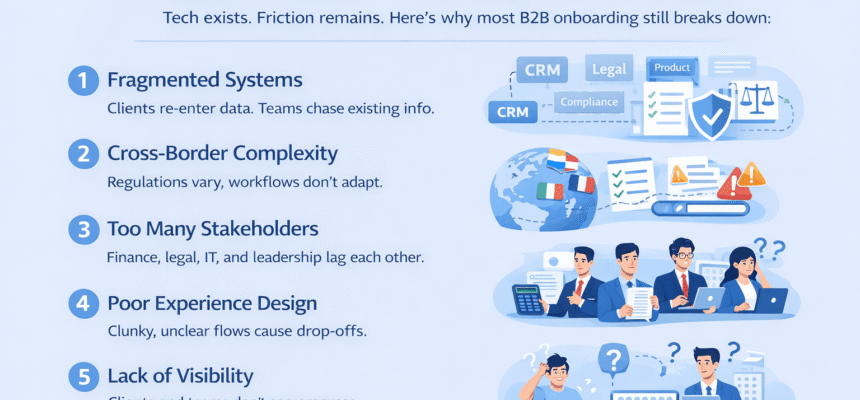
In the world of B2B customers, the stakes of customer onboarding are extraordinarily high. Unlike B2C relationships — where a single individual makes a purchase decision and uses a product independently — B2B onboarding involves multiple stakeholders, complex workflows, significant financial commitments, and long-term contractual relationships. Getting it right from the start isn’t just good practice; it’s a business imperative.
- 1. Start Onboarding Before Day One
- 2. Invest in a Thorough Discovery Process
- 3. Align on Goals and Success Metrics Early
- 4. Identify and Engage All Key Stakeholders
- 5. Run a Structured, Well-Prepared Kickoff Meeting
- 6. Deliver Early Wins Deliberately
- 7. Establish a Consistent Communication Cadence
- 8. Personalize the Onboarding Experience
- 9. Build a Scalable Onboarding Playbook
- 10. Measure, Collect Feedback, and Continuously Improve
- Conclusion
Research consistently shows that the onboarding experience is one of the strongest predictors of B2B customer retention. Companies that invest in structured, thoughtful onboarding see lower churn, higher product adoption, faster time-to-value, and stronger long-term revenue. Those who don’t often find themselves losing clients they worked hard and spent significant time and money to acquire.
So what separates great B2B onboarding from mediocre onboarding? Here are the most important B2B Customer Onboarding Best Practices to follow.
1. Start Onboarding Before Day One
The best B2B onboarding programs begin before the client ever logs in or receives their first deliverable. The moment a contract is signed, the onboarding clock starts ticking — and the first impression you make will color everything that follows.
Send a personalized welcome communication immediately after contract execution. Introduce the team they’ll be working with, outline what to expect in the first week, and provide any materials they need to prepare. This pre-onboarding communication reduces first-day anxiety, signals professionalism, and sets a positive tone for the entire relationship.
A detailed onboarding roadmap — shared upfront — shows the client that you have a clear plan and that their success is your priority from day one.
2. Invest in a Thorough Discovery Process
One of the most common B2B onboarding mistakes is rushing past discovery and jumping straight into delivery. In B2B relationships, understanding the client’s business deeply — their goals, challenges, internal processes, key stakeholders, and definition of success — is the foundation everything else is built on.
Conduct structured discovery sessions and use a comprehensive onboarding questionnaire to gather the information you need. Ask about short-term and long-term goals, existing workflows, technical environments, internal decision-making structures, and any previous experiences — positive or negative — with similar solutions.
The more thoroughly you understand your client’s world, the more precisely you can tailor your onboarding — and the more confident the client will feel that they’re in capable hands.
3. Align on Goals and Success Metrics Early
Misaligned expectations are the root cause of most B2B relationship failures. What the client believes they’re getting and what you believe you’re delivering are sometimes surprisingly different — even after a detailed proposal and contract process.
During onboarding, establish explicit, measurable success criteria. What does a successful outcome look like at 30, 60, and 90 days? What KPIs will you track together? What milestones will signal that the engagement is on track?
Getting this alignment documented and signed off early creates a shared definition of success that guides the entire relationship and provides an objective framework for performance reviews.
4. Identify and Engage All Key Stakeholders
B2B relationships involve multiple people on both sides. On the client side, there may be executive sponsors, day-to-day users, IT teams, finance contacts, and compliance officers — each with different priorities, concerns, and levels of involvement.
Map out the full stakeholder landscape early in the onboarding process. Understand who influences decisions, who uses the product or service daily, and who needs to be kept informed. Tailor your communication and engagement strategy to each group.
Failing to engage the right stakeholders at the right time is one of the most common — and most damaging — B2B onboarding oversights. An executive sponsor who feels out of the loop or a power user who feels unsupported can derail an otherwise healthy relationship.
5. Run a Structured, Well-Prepared Kickoff Meeting
The kickoff meeting is the centerpiece of B2B onboarding. This is where both teams come together to align on goals, agree on processes, establish communication norms, and lay the human foundation for the working relationship.
Prepare thoroughly. Share an agenda in advance, assign clear roles for the meeting, and ensure the right people are in the room on both sides. Cover scope, timelines, milestones, responsibilities, escalation paths, and success metrics. Leave time for questions and open discussion.
Always follow up with a written summary of what was discussed and agreed — including action items, owners, and deadlines. This document becomes the single source of truth for the early phase of the engagement.
6. Deliver Early Wins Deliberately
In B2B relationships, early wins are currency. They validate the client’s decision to choose you, build confidence in your team’s capabilities, and create positive momentum that sustains the relationship through the inevitable challenges ahead.
Identify the quickest, most meaningful result you can deliver in the first two to four weeks and prioritize it above everything else. This doesn’t have to be the biggest or most complex deliverable — it just needs to be something that demonstrates clear, tangible value and shows the client that the engagement is already paying off.
Celebrate these wins explicitly. Acknowledge them in your communications, reference them in check-in meetings, and use them to reinforce the narrative that the partnership is working.
7. Establish a Consistent Communication Cadence
In B2B onboarding, silence is dangerous. When clients don’t hear from you regularly, they fill the void with uncertainty — wondering whether things are on track, whether their account is being prioritized, and whether they made the right choice.
Establish a clear, consistent communication cadence from the very beginning. Weekly or bi-weekly check-in calls during the first 90 days, combined with regular written updates and progress reports, keep clients informed, engaged, and confident.
Be proactive rather than reactive. Don’t wait for clients to chase you for updates. Reach out before they feel the need to — and address potential concerns before they become complaints.
8. Personalize the Onboarding Experience
No two B2B clients are the same. A large enterprise with a complex technical environment has fundamentally different onboarding needs than a fast-growing startup deploying your solution for the first time. A client in the healthcare sector has different compliance considerations than one in retail.
Resist the temptation to run every client through the same generic onboarding template. Use the discovery process to understand each client’s unique context and adapt your approach accordingly. Personalization demonstrates that you see your clients as individuals — not just accounts — and it dramatically improves the quality of the onboarding experience.
9. Build a Scalable Onboarding Playbook
As your client base grows, the ability to deliver a consistently excellent onboarding experience becomes more challenging. The solution is a well-documented, continuously refined onboarding playbook.
Your playbook should cover every stage of the onboarding process: templates for welcome communications, discovery questionnaires, kickoff meeting agendas, progress report formats, and escalation procedures. It should be detailed enough that any member of your team can deliver a high-quality onboarding experience — and flexible enough to accommodate the individual needs of each client.
Review and update your playbook regularly, incorporating lessons learned from every onboarding engagement.
10. Measure, Collect Feedback, and Continuously Improve
Great B2B onboarding is never finished. The most successful companies treat their onboarding process as a living product — something that’s continuously measured, tested, and improved.
Track key onboarding metrics: time-to-value, onboarding completion rates, early engagement scores, and 90-day retention rates. At the end of the initial onboarding phase, ask clients directly how the experience felt — what worked, what was confusing, and what they wished had been different.
Use this data and feedback to make targeted improvements that benefit every client who follows. Even small refinements compound over time into a significantly better experience.
Conclusion
B2B customer onboarding is one of the highest-leverage activities in your entire business. The effort you invest in the first 30 to 90 days of a client relationship pays dividends for years — in retention, expansion revenue, referrals, and the kind of deep trust that makes your business genuinely difficult to replace.
The best B2B companies don’t just deliver great products and services — they deliver a great experience from the very first interaction. And it all starts with onboarding done right.
Your clients chose you. Now show them they made the right decision.